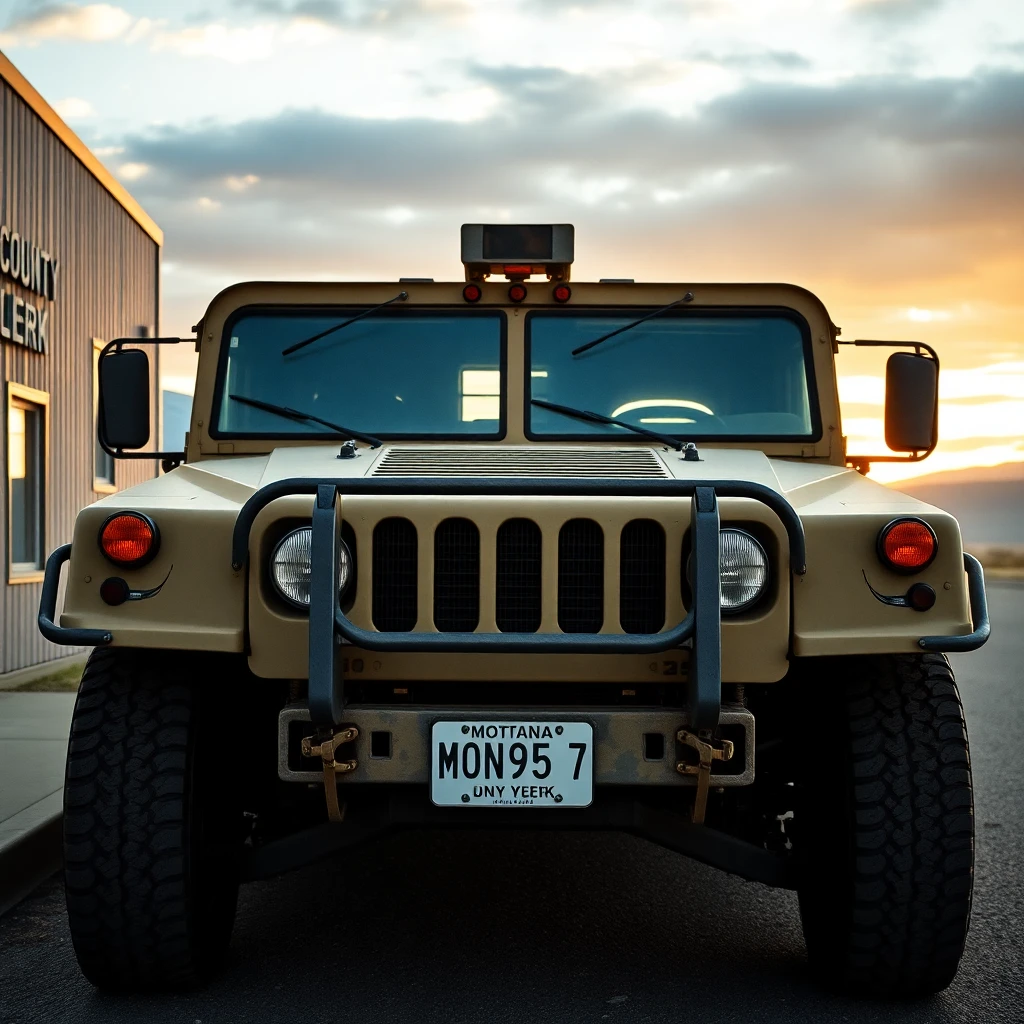
Humvee Lighting Requirements for Street Legal Operation: The Complete Guide
Humvee lighting is one of the most common gaps between a freshly purchased surplus HMMWV and a street-legal machine. The M998 and its variants leave DoD disposal with blackout drive lights, cat-eye marker lights, and zero civilian-standard lighting. That gap has to be closed before the vehicle can be registered and driven on public roads in any state.
This guide covers every lighting component a Humvee needs to meet civilian street-legal standards, the technical specifications required by federal and state law, how enforcement varies by state, how to handle the 24V-to-12V voltage challenge, what the installation costs look like, and what to do when the build is done and you are ready to register.
Why Stock HMMWV Lighting Does Not Meet Street Legal Standards
The Humvee was engineered for tactical operations, not public road compliance. Its lighting system was designed for low-visibility combat use, convoy operations, and compatibility with night vision devices. Understanding what the stock military lighting package includes is the first step toward knowing what has to change.
What the Factory Military Lighting Package Includes
| Component | Military Function | Civilian Compliance |
|---|---|---|
| Blackout drive light | Reduced-signature driving in combat environments | Not compliant , insufficient output |
| Blackout marker lights | Minimal visibility for convoy spacing | Not compliant , not DOT certified |
| Cat-eye marker lights | Passive reflectors visible to NVG systems | Not compliant , passive only, not active |
| Convoy rear light | Single-point convoy marker | Not compliant , not equivalent to a tail lamp |
| Blackout brake light | Minimal brake indication for following distance | Not compliant , output below FMVSS minimums |
| Military turn signals (some late variants) | Present on some production variants | May not meet flash rate or DOT requirements |
The military electrical system also operates at 24V rather than the 12V standard used in civilian vehicles. This means swapping bulbs does not work for most lighting components. A proper civilian lighting conversion requires either a 24V-to-12V DC converter or a partial rewire to a 12V subcircuit.
Federal Motor Vehicle Safety Standards That Apply
| FMVSS Standard | What It Covers | Key Requirement |
|---|---|---|
| FMVSS 108 | Lamps, reflective devices, associated equipment | All lighting devices must meet SAE/DOT specs for output, color, and placement |
| SAE J1383 | Headlight performance requirements | Minimum candela output at specific test points |
| SAE J945 | Turn signal lamps | 60-120 flash rate, minimum intensity, amber front, amber or red rear |
| SAE J1398 | Stop lamps (brake lights) | Minimum intensity, activation by brake pedal switch |
| SAE J1395 | Tail lamps | Must clarify when headlights are activated |
| SAE J587 | License plate illumination | Plate visible from 50 feet when headlights are on |
Complete HMMWV Lighting Requirements Checklist
1. Headlights
Requirement: Two forward-facing headlights with both high and low beam capability. Mounting height between 22 and 54 inches from the ground (measured to lamp center). Must carry DOT approval markings on the lens or SAE certification mark.
Output standard: Low beam must produce at least 75,000 millicandela at the beam center. High beam must produce at least 1,000,000 millicandela. SAE J1383 specifies the test points and minimum values.
Aiming: Misaligned headlights are the single most common inspection failure on HMMWV builds. Aim your headlights against a flat wall 25 feet in front of the vehicle. The low beam center should sit approximately 2 inches below horizontal. Adjust mounting brackets before any inspection appointment.
Common headlight solutions for HMMWVs:
- Direct-fit civilian headlight bucket conversion kits ($150 to $400): Replace the military headlight housing with a civilian bucket that accepts standard PAR46 or H4 sealed beams. Available from Military Truck Parts, HMMWV.com, and Blackwater Tactical.
- LED conversion kits ($200 to $600): HMMWV-specific LED assemblies that mount in the existing body cutouts and include integrated DOT-stamped lenses. These are the preferred solution for inspectors who check for DOT markings on the lens housing.
- Custom front light bars ($400 to $900): Tubular brush guard-mounted LED arrays with integrated DOT markers. More durable for off-road use, but confirm DOT compliance on the specific product before purchasing.
2. Tail Lights and Rear Lighting
Requirement: Two rear-facing red tail lamps visible from at least 500 feet in clear conditions. Must clarify when headlights are switched on. A center high-mount stop lamp (CHMSL) is required on many configurations depending on model year and state interpretation.
Installation note: The factory HMMWV rear lighting pod is often reused with a new LED insert. The key modification is ensuring the tail lamp circuit activates with the headlight switch rather than only through the military convoy light switch.
Common tail light solutions:
- HMMWV LED tail light pod replacements ($80 to $250 each): Direct-fit units that replace the factory pod with a DOT-compliant assembly including tail, brake, and turn functions integrated in one housing.
- Custom-mounted truck-style tail lights ($60 to $180): Standard trailer or truck tail lights on HMMWV custom brackets. Acceptable if DOT-stamped and properly wired.
3. Brake Lights (Stop Lamps)
Requirement: Two red stop lamps must clarify whenever the brake pedal is depressed. Visibility requirement is 300 feet (some states require 500 feet). The stop lamp must activate through a separate circuit from the tail lamp.
Critical wiring note: The stock HMMWV blackout brake light activates through a military-spec brake switch on the 24V circuit. A civilian brake lamp conversion requires either tapping the brake pedal switch mechanically or installing a pressure-sensitive brake light switch on the hydraulic line. The hydraulic pressure switch is the cleaner solution and is less dependent on the existing pedal hardware.
Brake light wiring failure is the most common reason a HMMWV fails a lighting inspection. If pressing the brake pedal does not clarify the rear stop lamps, the civilian brake switch is not wired correctly.
Cost: Hydraulic pressure brake switch and wiring: $40 to $120. LED stop lamp inserts are included in most tail light replacement kits.
4. Turn Signals
Requirement: Front and rear turn signals on both sides, flashing at 60 to 120 flashes per minute. Front signals must be amber. Rear signals must be amber or red. Visibility requirement is 300 feet for vehicles over a certain width. The HMMWV body is 85.6 inches wide, which triggers the wider vehicle requirements in most states.
Hazard flashers: Simultaneous activation of all four turn signals is required. Most conversions use a standard automotive flasher relay (12V) and a 4-way hazard switch routed through a civilian-style fuse block.
Side marker lights: Required on vehicles over 80 inches wide. Front side markers must be amber, rear side markers must be red. These are often integrated into the turn signal and marker lamp assemblies sold for HMMWV conversions.
Cost: Turn signal conversion kit with front and rear markers: $120 to $350. Hazard switch and relay: $25 to $80.
5. Reverse Lights
Requirement: At least one white light visible from the rear that activates when the vehicle is shifted to reverse. Most states accept a single reverse light, though two are standard on modern vehicles.
Installation note: Wire the reverse light to the transmission range sensor or a manual switch on the transfer case or gear selector. Many HMMWV builds use the neutral safety switch wire as a tap point for the reverse light circuit.
Cost: LED reverse light unit: $20 to $60.
6. License Plate Light
Requirement: The rear license plate must be illuminated when headlights are activated. The plate must be readable from 50 feet in darkness. This is one of the most frequently overlooked items in HMMWV builds, partly because many owners mount a custom rear plate bracket and never install the lamp.
Cost: Integrated plate light mount with LED lamp: $15 to $50. A simple LED pod on the plate bracket is fully acceptable in all states.
7. Reflectors
Requirement: Front amber reflectors and rear red reflectors are required. For vehicles over 80 inches wide (all HMMWV variants), front and rear side reflectors are also required. Most DOT-certified HMMWV lighting kits include the required reflectors.
Cost: Complete reflector set for HMMWV: $20 to $60.
The Voltage Problem: 24V Military vs 12V Civilian
The HMMWV's factory electrical system operates at 24V. Most civilian automotive lighting is designed for 12V systems. Connecting 24V power to a 12V LED lamp will either burn it out immediately or cause premature failure. There are three solutions:
Option 1: DC-DC Converter
Install a 24V-to-12V DC-DC converter and run the civilian lighting circuit off the converter output. The converter taps the main 24V bus and provides regulated 12V power to the lighting subcircuit. This preserves the stock 24V electrical system while allowing standard 12V lighting components.
Cost: Quality automotive DC-DC converter with 30A capacity: $40 to $120. Sufficient for running all lighting loads on a typical HMMWV build.
Option 2: Full 12V Rewire
Run a new 12V fuse block and wiring use from a voltage-regulated source or a dedicated 12V battery. All civilian lighting connects to the 12V circuit. The stock 24V circuit remains for military accessories and starter systems.
Cost: Full 12V lighting use and fuse block: $150 to $400 in parts, plus $300 to $700 in labor if done at a shop.
Option 3: 24V-Rated Components
Use lighting components specifically rated for 24V systems. Some commercial truck lighting designed for European heavy trucks operates at 24V natively. Fewer product choices exist at 24V, but this eliminates the voltage conversion step entirely.
Cost: 24V LED tail light sets: $80 to $250. 24V LED headlights: $150 to $400.
State-by-State HMMWV Lighting Enforcement
High-Enforcement States: Annual Inspection Required
These states run mandatory annual safety inspections that include a lighting check. An inspector will test every lighting function, confirm DOT markings on lens housings, and check headlight aim. Failures result in rejection and required reinspection within a set window.
| State | Inspection Frequency | Lighting Items Checked |
|---|---|---|
| Virginia | Annual | All lighting, headlight aim, DOT markings, CHMSL |
| Pennsylvania | Annual | All lighting, reflectors, DOT markings on lenses |
| New York | Annual safety + biennial emissions | All lighting, turn signal flash rate, brake light function |
| New Jersey | Biennial | All lighting, reflectors, headlight aim |
| New Hampshire | Annual | All lighting, headlight aim, turn signal compliance |
| Vermont | Annual | All lighting, reflectors, hazard flashers |
| Maine | Annual | All lighting, DOT markings, headlight aim |
| Massachusetts | Annual | All lighting, reflectors, headlight aim |
| Louisiana | Annual | All lighting, reflectors, side markers |
| Texas | Annual | All lighting; emissions tested separately |
| Rhode Island | Annual | All lighting, headlight aim |
| North Carolina | Annual | Lighting, brake lights, turn signals |
Medium-Enforcement States: Initial Registration Inspection Only
Some states require inspection only when a vehicle is first registered in that state, with no periodic inspection thereafter. Maryland runs this model for most non-commercial vehicles. Ohio requires inspection at initial title application. These states check lighting as part of the initial inspection but do not reinspect annually. A fully compliant lighting build passes once and requires no further inspection.
Low-Enforcement States: No Required Inspection
Montana, Florida, South Dakota, Wyoming, Michigan, Iowa, Mississippi, and several other states do not run periodic safety inspections. Lighting compliance is technically required under federal equipment standards and state motor vehicle codes, but there is no inspection station checkpoint. Law enforcement may cite equipment violations observed on the road, but there is no annual certification requirement.
For HMMWV owners in these states, the practical standard is: install a complete, functioning civilian lighting package that covers all required functions. You will not be inspected at registration, but you should operate equipment that complies with your state's motor vehicle code to avoid roadside citations and for basic road safety.
HMMWV Lighting Installation Guide
Tools and Materials
- 12V or 24V LED lighting kit designed for HMMWV applications
- DC-DC converter if using 12V lighting on the 24V HMMWV system
- Automotive-grade wiring: 12 AWG for main power runs, 16 AWG for lighting circuits
- Weatherproof connectors (Deutsch DT series is the professional standard for military vehicle applications)
- ATC fuse block (6 to 12 circuit) for the lighting subcircuit
- Headlight aim tool or flat wall with tape measure
- Multimeter for circuit testing
Installation Sequence
- Establish the voltage source first. Install the DC-DC converter or set up the 12V subcircuit before running any wiring. All subsequent lighting circuits run off this source.
- Install the fuse block near the converter output in a location protected from water intrusion and accessible for fuse replacement.
- Run the headlight circuit. Power from fuse block to headlight relay, then from relay to headlight assemblies. Install the headlights in their mounting positions and secure the lens housings.
- Run the rear lighting circuit. A single 4-wire run from the fuse block to the rear of the vehicle handles tail, brake left, brake right, and ground. Use Deutsch connectors at the rear body panel for a weatherproof connection.
- Install front turn signals in the existing body cutout positions. Use amber lenses on the front.
- Install the brake switch. Hydraulic pressure switch on the brake line or a mechanical pedal-mounted switch. Test by pressing the brake pedal and confirming rear stop lamps clarify.
- Install hazard flasher relay and switch. Route the switch to a convenient dash location. Test by activating hazards and confirming all four corners flash simultaneously at the correct rate.
- Install the license plate light on the plate bracket. Connect to the tail lamp circuit so it illuminates with headlights on.
- Install reflectors at required positions: front amber, rear red, and side markers (amber front, red rear).
- Aim headlights. Park 25 feet from a flat wall, mark the center height of each headlight on the wall. The low beam center should be 2 inches below horizontal. Adjust mounting brackets as needed before testing.
Pre-Inspection Test Sequence
Run this complete test before any registration appointment or inspection:
- Headlights: Both high beam and low beam on both sides
- Tail lights: clarify with headlights on, extinguish with headlights off
- Brake lights: Both sides clarify with brake pedal depressed
- Left turn signal: Front and rear left flash at 60 to 120 bpm
- Right turn signal: Front and rear right flash at 60 to 120 bpm
- Hazard flashers: All four corners flash simultaneously
- Reverse lights: clarify when vehicle is shifted to reverse
- License plate light: Illuminated with headlights on
- Side markers: All four clarify
Cost Summary: HMMWV Civilian Lighting Conversion
| Component | DIY Parts Cost | Installed at a Shop |
|---|---|---|
| Headlight conversion kit (pair) | $150 to $600 | $350 to $900 |
| Tail/brake/turn pod (pair) | $160 to $500 | $300 to $700 |
| Front turn signal assemblies (pair) | $80 to $200 | $150 to $350 |
| DC-DC converter (24V to 12V) | $40 to $120 | $100 to $250 |
| Fuse block and wiring use | $80 to $300 | $250 to $600 |
| Brake switch (hydraulic pressure type) | $20 to $60 | $60 to $150 |
| Hazard relay and switch | $25 to $80 | $60 to $150 |
| License plate light | $15 to $50 | $30 to $80 |
| Reflector set | $20 to $60 | $40 to $100 |
| Reverse lights | $20 to $60 | $60 to $120 |
| Total range | $610 to $2,030 | $1,400 to $3,400 |
Complete HMMWV civilian lighting kits from vendors like Blackwater Tactical, Military Truck Parts, and HMMWV.com bundle most of these components at $600 to $1,500 depending on quality and whether the wiring use is included. A bundled kit is often cheaper than sourcing components individually and ensures compatibility across all components.
Frequently Asked Questions: Humvee Lighting Requirements
Can I use my stock military headlights if I upgrade to DOT-compliant bulbs?
No. DOT compliance is determined by the lens assembly, not just the bulb. The stock military headlight housing is not DOT-certified. Even if you install a DOT-rated bulb inside the military housing, the assembly itself will not pass a lighting inspection in states that check for DOT markings on the lens. Replace the housing with a DOT-certified unit.
Do I need a center high-mount stop lamp (CHMSL) on my HMMWV?
The CHMSL has been required on new passenger cars since 1986 and on light trucks since 1994. Most surplus HMMWVs were manufactured before or around the light truck threshold. Whether a CHMSL is required for your specific vehicle depends on your state's interpretation of model year and vehicle class. For inspection states, installing one is safer than risking a failure on this item. LED CHMSL units are $20 to $60 and mount cleanly on the rear body panel or roof rack.
What is the most common lighting failure point on a HMMWV?
Brake light circuit failure is the most common issue. The stock military brake light circuit is separate from the civilian brake pedal switch circuit, and many conversions miss this step. If pressing your brake pedal does not clarify the rear stop lamps, the civilian brake switch is not wired correctly or is absent. This is a quick fix once identified but an automatic inspection failure if missed.
Which states most commonly fail HMMWVs on lighting inspections?
Virginia, Pennsylvania, and New York have the most rigorous programs. Headlight aim issues are the most common Virginia failure. Turn signal flash rate failures and missing reflectors are most common in Pennsylvania. New York inspectors specifically check for DOT markings on lens assemblies, which catches builds using non-DOT-certified aftermarket lenses. Calling ahead to an inspection station before your appointment and confirming they have experience with military vehicle conversions is worth doing in any of these states.
Can I drive my HMMWV at night before the lighting conversion is complete?
No. Operating a vehicle at night without functioning headlights and tail lights is a moving violation in every state, and a genuine safety hazard. HMMWVs sit significantly higher than passenger cars, and their profile without civilian lighting can be difficult for other drivers to see in time to react. Complete the lighting conversion before any night driving.
Are there HMMWV-specific lighting kits that cover everything in one package?
Yes. Several vendors sell complete HMMWV civilian conversion lighting kits that include all required components: headlights, tail/brake/turn pods, front turn signals, side markers, reverse lights, reflectors, and wiring harnesses. Blackwater Tactical, Military Truck Parts, and HMMWV.com each offer complete kits in the $600 to $1,500 range depending on component quality and whether a use is included. A complete kit ensures all parts are designed to work together and typically results in cleaner wiring than sourcing components piecemeal.
How long does a HMMWV lighting conversion take?
A DIY conversion using a complete kit with clear instructions typically takes one full weekend (8 to 16 hours) for someone with basic automotive electrical experience. The DC-DC converter installation and fuse block wiring are the most time-consuming steps. A professional shop experienced with military vehicles can complete a full lighting conversion in one to two days. Shops that specialize in military vehicle conversions are available in states with large military populations: Virginia, North Carolina, Texas, Colorado, California, and Georgia.
Do I need to complete the lighting conversion before registering or after?
In states with safety inspections, the lighting must be complete and functional before registration. In states without safety inspections (Montana, Florida, South Dakota, and others), registration and lighting installation can technically happen in any order since no inspection checkpoint exists. Practically, you should complete the lighting conversion before driving on public roads regardless of the registration sequence, as operating a vehicle without required lighting is a moving violation in all 50 states.
What documentation should I bring to an inspection station for a HMMWV lighting inspection?
Bring the following to any formal inspection appointment: vehicle title or registration document, receipts or product specs showing the lighting components are DOT-certified, and a brief note on the modifications made (lighting kit brand and model, DC-DC converter installed). Inspectors who see organized documentation are more confident conducting the inspection. If you converted using a named commercial kit from a known vendor like Blackwater Tactical or Military Truck Parts, stating the kit name and model number is often sufficient documentation.