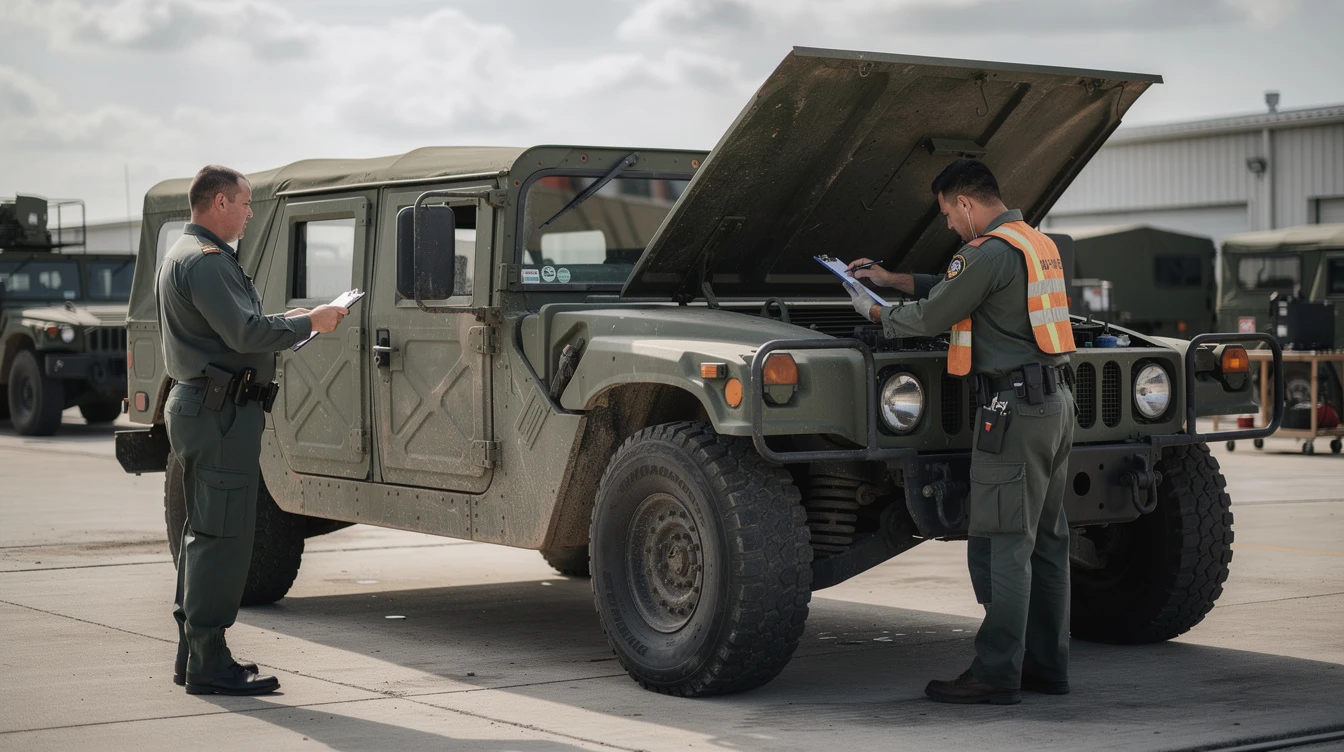
HMMWV Inspection Requirements: The Complete State-by-State Guide
Getting a military surplus HMMWV (High Mobility Multipurpose Wheeled Vehicle) street legal is one of the most rewarding projects a vehicle enthusiast can take on. But the inspection process is where many conversions stall. The HMMWV was engineered for combat , not for compliance with civilian Department of Transportation standards. Understanding exactly what inspectors look for, which states enforce strict requirements, and how to use legal pathways like Montana registration can save you thousands of dollars and months of frustration.
This guide covers every meaningful state inspection tier, the most common HMMWV failure points, what each required modification costs, and how the Montana LLC registration pathway legally eliminates the inspection requirement entirely for most owners.
Two Different Inspections: Safety vs. Emissions
Before diving into state requirements, it's important to understand that vehicle inspections fall into two completely separate categories. Conflating them is one of the most common mistakes HMMWV buyers make when planning their conversion.
Safety Inspections
A safety inspection verifies that a vehicle is mechanically fit to operate on public roads. Inspectors check brakes, steering, tires, lighting, mirrors, wipers, horn, and structural integrity. Safety inspections are performed by licensed mechanics at state-approved inspection stations. For HMMWVs, this is the bigger challenge , stock military configuration fails several civilian safety standards.
Emissions Inspections (Smog Checks)
An emissions inspection measures what comes out of the exhaust. It tests hydrocarbons, carbon monoxide, oxides of nitrogen, and particulate matter. Most HMMWVs run a 6.5L GM diesel engine. Diesel vehicles are exempt from OBD-II testing in most states (that test is designed for gasoline vehicles), but they are sometimes subject to opacity (smoke) testing or visible emissions checks. The good news: a well-maintained 6.5L diesel typically passes visible emissions tests without modification.
The key rule: Many states require one, neither, or both depending on the county, model year, and gross vehicle weight rating (GVWR). HMMWVs have a GVWR over 8,500 lbs in most configurations, which exempts them from passenger-car emissions standards in a large number of states.
What a Stock HMMWV Fails on Safety Inspection
A completely stock M998/M1025/M1035/M1097 will fail a civilian safety inspection in every state that conducts them. The military built these vehicles for a different operating environment. Here are the standard failure points:
1. Lighting
Military HMMWVs use blackout lighting systems with NATO-standard connectors. They may not have civilian turn signals, brake lights visible from standard distances, or side marker lights. Many configurations also lack a proper tail light housing that meets FMVSS (Federal Motor Vehicle Safety Standard) 108.
- Fix: Install DOT-approved civilian lighting kit. HMMWV-specific kits from vendors like Blackwater Tactical, Military Truck Parts, or AM General sourced parts run $300–$800 depending on configuration.
- Common add: LED conversion kits designed specifically for HMMWV body panels , these are plug-and-play for most variants and make inspection sign-off straightforward.
2. Mirrors
Federal standard requires a rearview mirror plus at least one side mirror (left side for driver visibility). Many surplus HMMWVs come with fold-flat troop mirrors, extended combat mirrors, or no mirrors at all. The combat mirrors typically satisfy requirements if properly secured and adjusted, but missing or damaged units need replacement.
- Fix: OEM HMMWV side mirrors or aftermarket stainless mirror assemblies. Cost: $50–$200 per mirror depending on style.
3. Windshield and Wipers
HMMWVs have a flat windshield with military-spec wiper systems. The main inspection issue is windshield condition , cracks, chips, or delamination in the driver's field of view will fail. Many surplus units arrive with field repairs, scratches from brush, or rock chips from decades of use. Wiper systems must sweep the required area and both blades must make clean contact.
- Fix: HMMWV replacement windshields run $200–$600. Wiper motors and blade refits are $80–$250. A fresh windshield is one of the best investments before inspection.
4. Tires
The most common tire on surplus HMMWVs is the 37×12.50-16.5 NDT (non-directional tire) , a military-specific size. These tires must meet DOT standards to pass inspection. Many surplus units have tires with military-only markings that inspectors will flag. Tread depth must meet the state minimum (usually 2/32" for most states, 4/32" for front tires in some).
- Fix: Michelin XML and Goodyear Wrangler MT/R tires are available in HMMWV sizes with full DOT certification. Budget $250–$450 per tire × 4 = $1,000–$1,800 plus installation. Some owners switch to more common 35" or 37" commercial sizes on military-style wheels.
5. Speedometer and Odometer
A functioning speedometer is required for safety inspection in virtually every state. Many decommissioned HMMWVs have non-functioning or missing speedometer clusters due to parts cannibalization. Odometer function is also checked in some states as part of inspection (odometer tampering laws).
- Fix: AM General speedometer clusters and cables are available through military surplus parts vendors. GPS-based digital speedometer kits ($150–$400) are also accepted in most states.
6. Horn
The factory HMMWV horn is electric and meets requirements, but it's frequently non-functional on surplus units due to wiring damage, corrosion, or cannibalization. This is a fast fail , inspectors check it in under 30 seconds.
- Fix: Universal horn relay and button kit. Cost: $20–$80. One of the cheapest fixes on the list.
7. Brakes
HMMWV brake systems are hydraulic disc with ABS on newer variants. Brake inspection checks pad thickness, rotor condition, caliper operation, brake fluid condition, and overall stopping function. Surplus vehicles with high mileage often need rotors and pads. The HMMWV front spindles are a known weak point , some inspectors specifically check for proper brake balance between sides.
- Fix: Budget $300–$700 for a full brake refresh depending on the variant. Use military-spec replacement parts or quality civilian equivalents that fit the M998-series hubs.
8. Seat Belts
Post-1968 vehicles require seat belts. HMMWVs have use-style military seat belts, which vary widely by year and configuration. Many surplus units have harnesses that are frayed, missing hardware, or non-retractable in ways that fail civilian inspection. Some states require three-point belts; military two-point lap belts may not meet current standards depending on model year classification.
- Fix: Military 3-point belt retrofit kits: $80–$250 per seat depending on seat type. Some owners use 4-point harnesses with use bars for a more secure setup.
9. Exhaust System
The exhaust must be intact, not leaking, and properly routed. HMMWV exhaust systems are prone to rust and physical damage from off-road use. Leaking exhaust is a fast safety fail in every state. Exhaust routing that exits abnormally (some upfitted units have top-mounted stacks) may require documentation or modification.
- Fix: HMMWV exhaust replacement systems: $200–$600 for a full catback. Top-stack conversions may require additional paperwork in some states.
State-by-State Inspection Tier Breakdown
States fall into four practical tiers HMMWV street legalization. Understanding which tier your state is in determines whether the Montana pathway makes financial sense, or whether a straightforward safety inspection is achievable.
Tier 1 , No State Inspection Required
These states do not require periodic safety inspections for registered vehicles. Once a HMMWV is titled and registered, it can operate legally on public roads without any inspection. Compliance with federal equipment standards (DOT-legal lights, working brakes, etc.) is still required under federal law, but there is no government checkpoint to clear.
- Alaska
- Arkansas
- Iowa
- Michigan
- Minnesota
- Mississippi
- Montana
- North Dakota
- Oregon (safety , emissions varies by county)
- South Carolina
- South Dakota
- Washington
- Wisconsin (most counties)
- Wyoming
For HMMWV owners in these states, the main hurdle is titling and registration , not inspection. And for owners in strict inspection states, these are the states to consider when structuring ownership.
Tier 2 , Safety Inspection Required, No Emissions
These states require a periodic safety inspection but do not emissions testing, or exempt diesel/heavy vehicles from emissions. The safety inspection is achievable on a properly prepared HMMWV.
- Alabama (annual safety)
- Connecticut (biennial safety, diesel exempt from OBD)
- Florida (safety inspection waived for non-commercial, but equipment standards enforced)
- Georgia (emissions only in 13 metro counties)
- Hawaii (annual safety)
- Idaho (no state inspection)
- Indiana (no safety, limited emissions)
- Kansas (no statewide inspection)
- Kentucky (no safety inspection)
- Louisiana (annual safety)
- Maine (annual safety)
- Missouri (no statewide safety inspection)
- Nebraska (no state inspection)
- Nevada (emissions in Clark/Washoe counties only; diesel GVWR 8500+ exempt)
- New Hampshire (annual safety)
- New Mexico (annual safety, 8500+ lb exempt from emissions)
- North Carolina (annual combined safety/emissions, diesel exempt from OBD test)
- Oklahoma (no statewide safety inspection)
- Rhode Island (annual safety)
- Tennessee (emissions limited to specific counties)
- Texas (annual safety; emissions required in certain counties)
- Vermont (annual safety)
- Virginia (annual safety)
- West Virginia (annual safety)
Tier 3 , Full Safety + Emissions Required
These states run both safety inspections and emissions testing. For HMMWV owners, the safety inspection is the primary challenge. Emissions testing for diesel vehicles over 8,500 lbs GVWR is either waived or limited to visible smoke/opacity tests in most of these states.
- California , strictest in the nation; CARB (California Air Resources Board) regulates all vehicles, including imported military surplus. Pre-1976 vehicles exempt from smog; 1976+ vehicles require full compliance or a CARB exemption. Heavy-duty diesel vehicles require opacity tests.
- Colorado , OBD test for gasoline; diesel vehicles over 8,500 lbs GVWR typically exempt from OBD but may face opacity testing in metro counties.
- Delaware , annual safety + biennial emissions; diesel vehicles 8,500+ lb exempt from OBD emissions.
- Maryland , annual emissions (OBD2 for gas; opacity for diesel); safety inspection only at initial registration.
- Massachusetts , annual safety + emissions; diesel 8,500+ lb exempt from OBD; visual/opacity test applies.
- New Jersey , biennial safety + emissions; GVWR 8,500+ lb exempt from OBD but subject to smoke opacity test.
- New York , annual safety + biennial emissions; diesel heavy vehicles tested by visual opacity, not OBD.
- Ohio , emissions testing in 7 counties only; safety inspection at initial registration.
- Pennsylvania , annual safety + biennial emissions in 25 counties; diesel 8,500+ GVWR often exempt from OBD test.
- Utah , annual safety; emissions in Wasatch Front counties.
Tier 4 , California: Special Category
California deserves its own category. CARB regulations apply independent of federal standards, and the agency specifically regulates military surplus diesel vehicles imported for on-road use. Pre-1976 HMMWVs (extremely rare) are exempt. Post-1976 through 2000 models require compliance with CARB's Heavy-Duty Off-Road (HDOR) or Heavy-Duty On-Road (HDON) standards. The practical result: titling a diesel HMMWV for street use in California is significantly more complex than any other state and often requires professional compliance work costing $2,000–$8,000+.
For HMMWV owners in California, the Montana LLC pathway is the most common legal solution. Properly structured Montana ownership means the vehicle is titled and registered in Montana (no emissions, no inspection) and can be transported to California for use. This is a legal structure used by hundreds of thousands of California vehicle owners , consult a qualified attorney to structure it correctly for your situation.
Antique and Historic Vehicle Exemptions
Many states offer antique, historic, or vintage vehicle designations that exempt vehicles from safety and emissions inspections. The eligibility threshold is usually 25 years old, though some states use 15 or 20 years.
The HMMWV was first produced in 1984. This means early M998 series vehicles (1984–1986 production years) are now 40+ years old and qualify for antique status in every state that uses a 25-year threshold. The most common production years in surplus are 1990–1998, meaning a significant portion of the surplus HMMWV fleet will qualify for antique status by 2025.
States with Antique/Historic Exemptions and Their Thresholds
| State | Age Threshold | Annual Mileage Limit | Inspection Exempt? |
|---|---|---|---|
| Alabama | 25 years | None | Yes |
| Arizona | 25 years | None (show/parade use only) | Yes |
| California | 25 years | None stated (occasional use) | Yes , smog exempt |
| Colorado | 25 years | None | Yes |
| Connecticut | 20 years | None | Yes |
| Florida | 25 years | None | N/A (no state inspection) |
| Georgia | 25 years | None (hobby use) | Emissions exempt |
| Illinois | 25 years | None | Yes (emissions exempt) |
| Maryland | 20 years | None | Yes , emissions exempt |
| Massachusetts | 25 years | None | Yes |
| Michigan | 26 years | None | N/A (no state inspection) |
| New Jersey | 25 years | 3,000 miles/year | Yes |
| New York | 25 years | None (limited use) | Yes |
| North Carolina | 35 years | None | Yes |
| Ohio | 25 years | None | Emissions exempt |
| Pennsylvania | 25 years | None (occasional use) | Yes |
| Texas | 25 years | None (show/parade) | Yes |
| Virginia | 25 years | None | Yes |
| Washington | 30 years | None | N/A (no state inspection) |
Important note: Antique and historic plates typically carry use restrictions. "Occasional pleasure use," "show and parade use," or "hobby use" language in state statutes means you cannot use the vehicle as a daily driver. Some states are lenient about enforcement; others are not. Check your specific state's definition before relying on antique status for daily driving.
The Montana Registration Pathway for HMMWV Owners
Montana is in Tier 1 , no safety inspection, no emissions testing, ever. But Montana offers a much more powerful advantage for out-of-state HMMWV owners: registering through a Montana LLC allows residents of any state to title and register their HMMWV in Montana, regardless of where the vehicle is physically located.
How the Montana LLC Registration Works
- Form a Montana LLC. This is a legal business entity registered with the Montana Secretary of State. The LLC is the vehicle owner of record , not you personally.
- Title the HMMWV in the LLC's name. The LLC purchases the vehicle (you use the HMMWV with the LLC's permission as a member).
- Register in Montana. Montana registration is issued to the LLC. No inspection, no emissions test. Montana registration fees on a vehicle over 11 years old are modest.
- Use the vehicle in your home state. The vehicle displays Montana plates and is properly titled and registered in Montana. You are operating a Montana-registered vehicle in your state.
Why HMMWV Owners Choose Montana
- No inspection requirement , not now, not at renewal, not ever under current Montana law
- No emissions testing , Montana has no statewide emissions testing program
- Simpler title process , Montana's title process for military surplus vehicles is well-established and staffed with offices experienced in handling these cases
- No personal property tax , Montana does not charge annual personal property tax on vehicles (unlike Virginia, for example, which charges 4.15% of vehicle value annually)
- No sales tax , Montana has no state sales tax, which on a $25,000–$60,000 HMMWV can save $1,500–$5,000+ compared to home-state registration
What Montana Registration Does NOT Protect You From
Montana registration is a titling and registration solution. It does not exempt you from:
- Federal vehicle equipment standards , DOT-legal lights, working brakes, etc. are still required under FMVSS
- Your home state's traffic laws , speed limits, lane rules, insurance requirements
- Law enforcement stops based on equipment violations , if your headlights are out, you can be cited regardless of where the vehicle is registered
- Insurance requirements , your state requires you to carry insurance, and Montana-registered vehicles must still comply
The practical result: a HMMWV with properly functioning civilian-converted equipment, registered through a Montana LLC, can be driven legally in all 50 states without clearing a state inspection. This is the most common path taken by serious HMMWV owners who want to actually drive their vehicles.
Required Modifications Cost Summary
Here is a consolidated cost table for the most common inspection-related modifications, with parts-only and parts-plus-labor estimates:
| Modification | DIY Parts Cost | Installed (Shop) | Priority |
|---|---|---|---|
| DOT lighting kit (full) | $300–$800 | $600–$1,400 | Critical |
| Replacement windshield | $200–$600 | $400–$900 | High |
| DOT-rated tires (4) | $1,000–$1,800 | $1,200–$2,200 | High |
| Side mirrors (pair) | $100–$400 | $150–$500 | High |
| Brake refresh (pads + rotors) | $300–$700 | $600–$1,200 | High |
| Seat belt retrofit (per seat) | $80–$250 | $150–$400 | Medium |
| Speedometer repair/replace | $150–$400 | $250–$600 | Medium |
| Exhaust system | $200–$600 | $400–$1,000 | Medium |
| Horn | $20–$80 | $50–$150 | Low |
| Wiper motor/blades | $80–$250 | $150–$400 | Low |
Total realistic conversion budget for a stock HMMWV: $2,500–$8,000 DIY; $4,000–$12,000 at a shop. Higher-end estimates apply to vehicles in rough condition with multiple systems needing attention. Many owners who purchase well-maintained, dealer-prepared units spend considerably less.
Pre-Inspection Checklist for HMMWV Owners
Before taking your HMMWV to any inspection station, run through this checklist. An inspection failure wastes time and money , most states charge for reinspection, and some have waiting periods between attempts.
Lighting
- [ ] Headlights (high and low beam) , both working, properly aimed
- [ ] Tail lights , illuminated when headlights are on
- [ ] Brake lights , both sides clarify when pedal is pressed
- [ ] Turn signals , all four corners flash correctly
- [ ] Hazard flashers , all four corners flash together
- [ ] Reverse lights , clarify when in reverse
- [ ] Side marker lights , front amber, rear red
- [ ] License plate light , illuminated
Brakes
- [ ] Brake pedal firm (no spongy feel indicating air in lines)
- [ ] No brake fluid leaks visible at calipers, lines, or master cylinder
- [ ] Parking brake holds on a grade
- [ ] Brake pads above minimum thickness (2–3mm typical)
- [ ] Rotors not excessively scored or warped
Safety Equipment
- [ ] All seat belts present and latching correctly
- [ ] Horn audible
- [ ] Windshield , no cracks in driver's field of view
- [ ] Wipers clearing the required area cleanly
- [ ] Mirrors , driver's side mirror present and adjustable
- [ ] Speedometer reading accurately
Tires and Wheels
- [ ] Tread depth at or above state minimum (use tread depth gauge)
- [ ] No sidewall bulges, cuts, or cord showing
- [ ] Tires carry DOT markings
- [ ] Lug nuts torqued to spec
- [ ] No wheel wobble at hub
Steering and Suspension
- [ ] No excessive play in steering wheel
- [ ] Power steering fluid at correct level (if equipped)
- [ ] No pulling to one side under braking
- [ ] Tie rod ends and ball joints without excessive play
Exhaust
- [ ] No exhaust leaks audible or visible (use a flashlight in the engine bay)
- [ ] Exhaust properly routed and secured
- [ ] Diesel smoke not excessive at idle or under light throttle
Special Situations: Title Challenges That Affect Inspection
Demilitarized (DEMIL) Titles
Some surplus HMMWVs come through DRMO (Defense Reutilization and Marketing Office) disposal with a demilitarized title or a Form DD-1342 indicating disposition as scrap or parts only. These vehicles technically cannot be legally titled for on-road use in most states. If you have a DEMIL-coded vehicle, you need to verify that the title documents support road registration before investing in safety modifications. Montana's title examiners are experienced with military surplus titles and can advise on whether the paperwork is sufficient.
MSO (Manufacturer's Statement of Origin) vs. Title
Government surplus vehicles are often sold with an MSO rather than a civilian title. An MSO is the primary document used to establish first title. Montana accepts MSO documents for military surplus vehicles and can issue a Montana title directly from the MSO. This is another reason HMMWV owners favor the Montana pathway , Montana's title process handles government surplus documentation that many state DMVs are unfamiliar with.
VIN vs. Serial Number
Military HMMWVs use a serial number system (found on the data plate), not a standard 17-digit VIN. Many states require a VIN inspection (separate from a safety inspection) before issuing a title. Montana issues Montana VINs to military surplus vehicles that don't carry a standard civilian VIN, simplifying the registration process. See our complete guide to HMMWV VIN verification for details on locating military data plates and what documentation to bring to the VIN inspection.
Working With an Inspection Station on a HMMWV
Not every inspection station is comfortable inspecting a military vehicle. HMMWVs don't look like any civilian vehicle they've seen, and some inspectors will refuse to inspect a vehicle they're not familiar with. Here are practical approaches:
- Call ahead. Phone the inspection station before driving over. Explain that you have a military surplus HMMWV that's been converted for civilian use. Ask if they inspect modified or specialty vehicles. A "no" on the phone saves a wasted trip.
- Bring documentation. Bring your title documents, a list of the civilian-spec modifications you've made, and any receipts or certifications for DOT-certified parts. An inspector who can see that you've installed DOT-rated lights and tires is more confident in the inspection.
- Ask about pre-inspection consultations. Some shops that work on off-road builds or military vehicles offer a pre-inspection walkthrough where they identify likely failures before you schedule a formal inspection. This saves time and reinspection fees.
- Find military vehicle specialty shops. In states with large military populations (Virginia, North Carolina, Texas, Colorado, California, Georgia), shops specializing in military vehicle conversions exist and are familiar with what inspectors want to see on a HMMWV.
Frequently Asked Questions
Do I need to convert my HMMWV before applying for a title?
In most states, titling and inspection are separate processes. You can often title the vehicle first (establishing legal ownership), then complete the safety conversion before scheduling inspection. The Montana LLC pathway titles the vehicle without any conversion requirement , you can then drive the vehicle to a shop for conversion work using the Montana plates.
Can I drive my HMMWV on public roads while waiting for registration?
In most states, a temporary operating permit (also called a transit plate or dealer permit) allows you to drive a newly purchased vehicle for 30–90 days while completing the registration process. Montana issues transit permits for out-of-state buyers. Check your specific state's rules , some states will not issue a transit permit for a vehicle that hasn't passed inspection.
Does my HMMWV need to pass emissions if it's a diesel?
In most states: no, or only a simple opacity (visible smoke) test. The HMMWV's 6.5L GM diesel has a GVWR that exceeds 8,500 lbs in all standard configurations, which exempts it from OBD-II testing designed for passenger cars. Visible smoke inspections are easy to pass on a well-maintained diesel. California is the major exception , see the Tier 4 section above.
My HMMWV doesn't have a standard 17-digit VIN. Is that a problem?
Yes, in most states. Military vehicles use a different numbering system. States that are unfamiliar with military surplus will struggle to process the title. Montana has established procedures for assigning civilian VINs to military surplus vehicles, which is why so many HMMWV owners use Montana registration. See our VIN verification guide for the full process.
Can I get antique plates on a HMMWV?
Yes, if the vehicle is 25+ years old (35+ in North Carolina) and your state offers antique or historic designation. Most HMMWV surplus sold through GovPlanet and similar auctions is from the early-to-mid 1990s, making many units eligible today. Antique plates often carry use restrictions , verify your state's rules before relying on antique status for regular driving.
What's the cheapest legal path to driving a HMMWV on the street?
For most buyers outside California: form a Montana LLC, title the HMMWV through the LLC, complete the required safety conversion (lights, mirrors, DOT tires, functional brakes), and drive on Montana plates. The Montana registration itself is low-cost, there's no inspection to pass, and you avoid home-state sales tax and personal property tax. Total cost for a basic conversion plus Montana LLC formation typically runs $3,000–$6,000 depending on the vehicle's condition, compared to $5,000–$15,000 for a full California-compliant conversion. See our complete Montana LLC guide for full details on the process.
Do I need special insurance for a HMMWV?
Standard auto insurance carriers are often reluctant to insure military surplus vehicles. Specialty insurers (Hagerty, Grundy, American Collectors, Heacock Classic) specifically underwrite military surplus and specialty vehicles. Coverage terms typically require agreed value coverage (not actual cash value), and may limit annual mileage. Budget roughly $800–$2,500/year for a properly insured HMMWV depending on stated value and usage.
Is it legal to drive a HMMWV on the highway?
Yes, provided it is properly titled, registered, insured, and meets DOT equipment standards. The HMMWV was designed for high-speed road operation , it's fully capable of highway speeds. The standard top speed on a stock M998 is approximately 70 mph, which is adequate for most U.S. highways. Some states have width restrictions that may technically apply to wider-body HMMWV variants, but enforcement is rare on standard-width units.