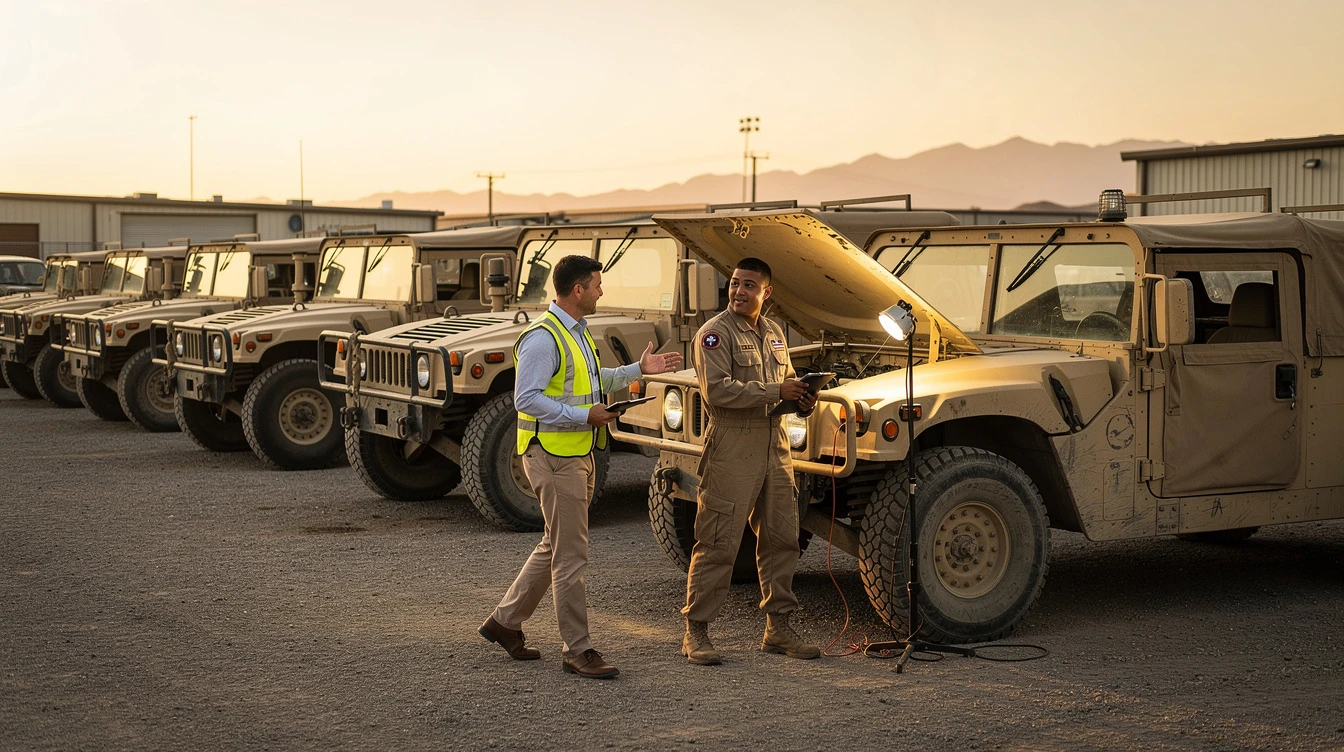
Humvee street legal modifications are the first thing most new HMMWV owners search for, and for good reason. A surplus military vehicle rolls off a GovPlanet auction with zero civilian safety equipment. No mirrors, no horn, no brake lights that meet your state's standard. Getting it properly plated requires a specific list of physical changes, plus paperwork that most DMVs aren't familiar with.
I went through this exact process with my grandfather's 1985 HMMWV. What I learned fast is that the modification list and the registration path are two separate problems, and you have to solve both. This guide covers the physical modifications your Humvee needs, how state requirements vary, what documents you'll need, and how to get registered without wasting months fighting your local DMV.
Skip ahead to the FAQ if you already know what modifications your rig needs and just want help with registration. Otherwise, read through, there are details in here that most guides skip entirely.
What Humvee Street Legal Modifications Are Actually Required
There's no single federal standard for making a military vehicle street legal, it's largely a state-by-state decision. That said, most states pull from the same baseline. Knowing the common floor helps you build a modification list that'll hold up anywhere you might want to register.
Lighting: The Non-Negotiable Starting Point
Your stock HMMWV almost certainly doesn't meet civilian lighting standards. Military spec lighting is designed for tactical use, not road compliance. At a minimum, you'll need functioning headlights (both high and low beam), tail lights, brake lights, and turn signals on all four corners. Many states also require side marker lights and a rear license plate light.
The M998 and M1097 variants often have functional headlight assemblies but missing or non-functional turn signals and brake lights. Budget for a proper civilian wiring use conversion or at least a relay-based add-on system. Don't cheap out here, lighting failures are the number one reason HMMWVs get failed at inspection in states that require one.
Mirrors, Horn, and Safety Glass
Every state requires at minimum a driver's side rearview mirror. Most require both side mirrors and a rear-view mirror or camera system if the rear window is obstructed. Factory HMMWV mirrors are functional but the mounting hardware is often degraded on surplus units. Check and replace before you go to registration.
A working horn is required in every state. Many surplus units have non-functional horns or missing horn buttons entirely. It's a five-minute fix but don't skip it. Windshield glass must also be DOT-compliant safety glass, check for cracks or chips that would fail a visual inspection in stricter states.
Speedometer, Odometer, and Brakes
This one trips people up. A lot of surplus HMMWVs come with non-functional or missing speedometers. Several states explicitly require a working speedometer for registration. Get it working. Same goes for your braking system, all four wheels must have functional brakes, and if your HMMWV has a trailer brake provision, make sure it's not bleeding pressure from the main system.
For a deeper look at what inspectors check in specific states, read the VIN inspection military vehicle state requirements guide, it covers what each state's inspector is actually looking for and how to prep your HMMWV accordingly.
HMMWV Street Legal Modifications by Variant
Not all HMMWVs start from the same baseline. An M998 cargo/troop carrier has different stock equipment than an M1097 heavy variant or an M1025 armament carrier. The modification work required tracks closely with what the military originally installed.
M998 and M1097: Most Common Surplus Units
The M998 is the most common unit on the civilian market. It typically has a functional lighting base to work from, but the turn signal wiring is often incomplete or missing. The M1097 heavy HMMWV is similar but adds weight class considerations in some states. Both variants are generally workable without major structural changes.
Check out the M1097 HMMWV registration vs M998 differences guide for a clear breakdown of how the two variants are treated differently during registration in various states.
M1025 and M1026 Armed Variants
These come with additional considerations beyond standard modifications. The ring mount and armor provisions need to be properly demilitarized before registration in most states. The DEMIL classification on your SF-97 or DD-1348 matters here. If your paperwork shows an armed variant, some states will require additional documentation before issuing a title.
The M1025 M1026 HMMWV armed military vehicle registration guide goes deep on what the demilitarized HMMWV vs civilian Humvee distinction means for your title paperwork.
Civilian H1 vs Military HMMWV: Don't Confuse the Two
A civilian AM General H1 (sold through dealers from 1992 to 2006) already meets DOT standards from the factory. It has a standard title and registers like any other vehicle. A surplus military HMMWV does not. The modification list above applies to military surplus units only. If you're buying what's advertised as an "H1," confirm whether it's a civilian-titled unit or a military surplus vehicle being sold under a different name.
State-by-State Differences for Military Vehicle Street Legal Requirements
This is where most HMMWV owners get frustrated. Your modification list is consistent, but the inspection and registration process varies dramatically by state. Some states are simple. Others make the process genuinely difficult.
States With Lenient Military Vehicle Registration Paths
Montana is the easiest state to register a military surplus vehicle in. No sales tax, no emissions testing, no mandatory inspection for registration. The state accepts SF-97 and DD-1348 documents as proof of ownership and issues a proper Montana title. This is why Montana registration is so common in the military vehicle community, it works cleanly for exactly this type of vehicle.
South Dakota is another strong option, particularly if you want a state with straightforward title transfer requirements. Both states are fully remote-friendly, meaning you don't need to drive your HMMWV to the DMV in person.
For a clear side-by-side on both options, the South Dakota vehicle registration vs Montana comparison covers the key differences so you can choose the right path for your situation.
States That Require Physical Inspection
California, New York, and several other states require a VIN inspection or safety inspection before a title can be issued to a military surplus vehicle. California is particularly strict. If you're in a state like this, Montana LLC registration is often the cleaner path because it bypasses the in-state inspection requirement entirely.
If you're in California specifically, read the HMMWV registration California complete guide before you do anything else. The California process has specific requirements that can catch people off guard.
What DOT Actually Requires for Military Vehicles on Public Roads
The DOT requirements for military vehicles page covers what federal rules actually apply versus what's state-level discretion. Short version: federal DOT standards apply to manufacturers, not necessarily to individuals operating surplus vehicles. But states can and do impose their own standards. Know the difference before assuming federal exemptions protect you at the state level.
| Modification | Required in Most States | Notes |
|---|---|---|
| Headlights (Hi/Lo beam) | Yes | DOT-compliant bulbs required |
| Tail lights + brake lights | Yes | Must be wired to brake pedal |
| Turn signals (4 corner) | Yes | Front and rear, both sides |
| Driver-side mirror | Yes | Passenger side typically required too |
| Working horn | Yes | Simple fix, don't skip it |
| DOT safety glass windshield | Yes | Check for cracks before inspection |
| Working speedometer | Most states | Required for registration in many states |
| Emissions compliance | Some states | Montana and SD have no emissions test |
| License plate light | Yes | Rear plate must be clarifyd |
| Functional brakes (all 4 wheels) | Yes | Inspect brake lines on surplus units |
The Title and Registration Paperwork Side
Modifications get your HMMWV physically ready for the road. Paperwork gets it legally on the road. These are separate steps, and the paperwork side is where most people lose months of time.
SF-97 vs DD-1348: Which Document Do You Have?
Most surplus HMMWVs sold through government auction come with either an SF-97 (the government's certificate of release for a motor vehicle) or a DD-1348 (the disposal/transfer document). The SF-97 is the stronger document for titling purposes, it's essentially the military equivalent of a title. The DD-1348 is a release/disposal document and requires more work to convert into a civilian title.
The DD-1348 vs SF-97 military vehicle documents guide breaks down exactly what each document is, which states accept which, and what to do if you only have one of them.
Getting a Montana Title from Military Documents
Montana accepts both the SF-97 and DD-1348 as the basis for issuing a civilian title. The process runs through a Montana LLC if you're an out-of-state owner, the LLC holds the vehicle, Montana issues the title and plates, and you operate it in your home state under Montana registration. No sales tax. No emissions. No inspection required for registration purposes.
For the full Montana LLC angle, the Montana LLC vehicle registration benefits page covers why this structure works and what the annual maintenance looks like. You can also check the official Montana Vehicle Title and Registration page for state fee schedules.
Army Surplus Registration Plates: What to Expect
Once your title is issued, getting army humvee surplus registration plates is straightforward through Montana. You'll receive physical plates by mail. The registration is issued in the name of your Montana LLC and renewed annually. The whole process is remote, you never need to physically appear at a Montana DMV office.
Timeline from document submission to plates in hand is typically 3 to 6 weeks depending on document quality and current processing volume. If you want a more detailed military humvee registration timeline, the HMMWV new owner complete registration guide 2025 walks through every stage with realistic time estimates.
DIY vs Professional Registration Help: Real Talk
Honestly, the physical modifications on a HMMWV are DIY-friendly for anyone with basic mechanical skills. The paperwork is where people consistently burn time and money going it alone. Here's why.
Why DIY Paperwork Goes Wrong
DMV clerks in most states have never processed an SF-97. They don't know what it is, they're not sure what to do with it, and they often kick it back pending additional documentation that may or may not actually be required. I've seen people spend six months going back and forth with their county DMV over a document issue that a specialist could have resolved in a week.
If your title documents are clean and your state is HMMWV-friendly, DIY is totally workable. If you're in a strict state, have a DD-1348 instead of an SF-97, or have any title complications, professional help is worth it. The time value math is pretty clear, especially when you factor in the cost of a failed registration attempt.
What a Specialist Actually Does for You
A military vehicle registration specialist knows which states will accept which documents, how to structure the Montana LLC correctly, how to handle title issues before they become problems, and how to get your plates without in-person DMV visits. The process is fully remote and handled with our paperwork support.
Verified customer reviews on our platform consistently highlight the value of having someone who knows the military document chain handle the paperwork side. The physical modifications are your job. The registration paperwork is ours.
For insurance, which is a separate but equally important piece of the puzzle, the HMMWV insurance military surplus vehicle complete guide covers what you need to carry and which insurers actually write policies on surplus military vehicles. Getting registered and getting insured are two separate steps, don't skip either.
If you want a broader view of registration costs across states, the military vehicle registration cost savings calculator is a useful tool for seeing how Montana stacks up against your home state's fees and taxes.
Frequently Asked Questions About Humvee Street Legal Modifications
Can you make a Humvee street legal in any state?
In most states, yes. A surplus HMMWV can be made street legal with the right physical modifications and proper title documentation. The process is more involved in states like California and New York, which require VIN inspections or emissions compliance. The easiest paths run through Montana or South Dakota registration, which have minimal inspection requirements and no emissions testing. Most HMMWV owners in strict states use a Montana LLC to register remotely and avoid the in-state DMV process entirely.
Is a HMMWV street legal from the factory?
No. Military surplus HMMWVs are built to military specification, not civilian DOT standards. They typically lack compliant turn signals, may have missing or non-functional brake lights, and often don't have a DOT-stamped windshield. A civilian AM General H1 is factory street legal because it was built and certified for civilian sale. A surplus military HMMWV requires modifications before it can be registered and operated on public roads in most states. The scope of work varies by variant and the condition of the individual vehicle.
What documents do I need to title a surplus HMMWV?
The primary document is either an SF-97 (Standard Form 97, Certificate of Release of a Motor Vehicle) or a DD-1348 (the DoD disposal/transfer document). The SF-97 is the preferred document for titling because it functions most like a civilian title. If you have a DD-1348, you'll need additional steps to convert it. Montana accepts both. Some states only accept the SF-97. The SF-97 form military vehicle title document guide covers exactly how to use each document in the title process.
Do I need an emissions test for my HMMWV?
It depends on the state. Montana and South Dakota have no emissions testing requirements. States like California and several northeastern states have strict emissions standards that can be very difficult for a surplus diesel HMMWV to meet. This is one of the primary reasons military vehicle owners register through Montana, the state has no emissions test, so the vehicle qualifies for registration regardless of its emissions profile. Check the emissions requirements for military vehicles page for a breakdown by state.
How long does it take to get HMMWV plates through Montana?
Once your documents are submitted and the Montana LLC is formed, the title and registration process typically takes 3 to 6 weeks. Physical plates arrive by mail. The timeline can vary based on document quality, a clean SF-97 moves faster than a DD-1348 that needs additional processing. Using a specialist generally speeds things up because document issues get caught and resolved before submission rather than after a rejection from the state.
What's the difference between a demilitarized HMMWV and a civilian Humvee?
A demilitarized HMMWV is a military surplus unit that has had weapons systems, classified equipment, and tactical modifications removed per DoD DEMIL requirements before being released to the civilian market. A civilian Humvee (H1) was purpose-built for civilian sale by AM General and never had military systems. From a registration standpoint, the demilitarized HMMWV requires SF-97 or DD-1348 documentation to title, while a civilian H1 has a standard title like any other vehicle. The physical modification requirements for street use are similar, but the paperwork path is very different.
Do I need a special license to drive a HMMWV on public roads?
In most states, a standard driver's license is sufficient to operate a street-legal HMMWV. The HMMWV's GVWR typically falls under the commercial license threshold. However, some states have weight class provisions that can require a Class B license for heavier variants. Check your state's DMV requirements for vehicles over 10,000 lbs GVWR to be sure. The how to register military vehicle by state FAQ includes license class notes for several common states.
Getting your Humvee street legal modifications sorted is the mechanical side of the job. Getting properly titled and plated is the paperwork side. Both matter, and both have specific steps that can go wrong if you don't know what to expect. If you've got your modifications dialed in and need help with the registration path, that's exactly what we do. Reach out and we'll find the right route for your specific vehicle and state situation.
For a complete overview of the entire ownership and registration process from purchase to plates, the street legal humvee guide is the best place to start.
Related Reading