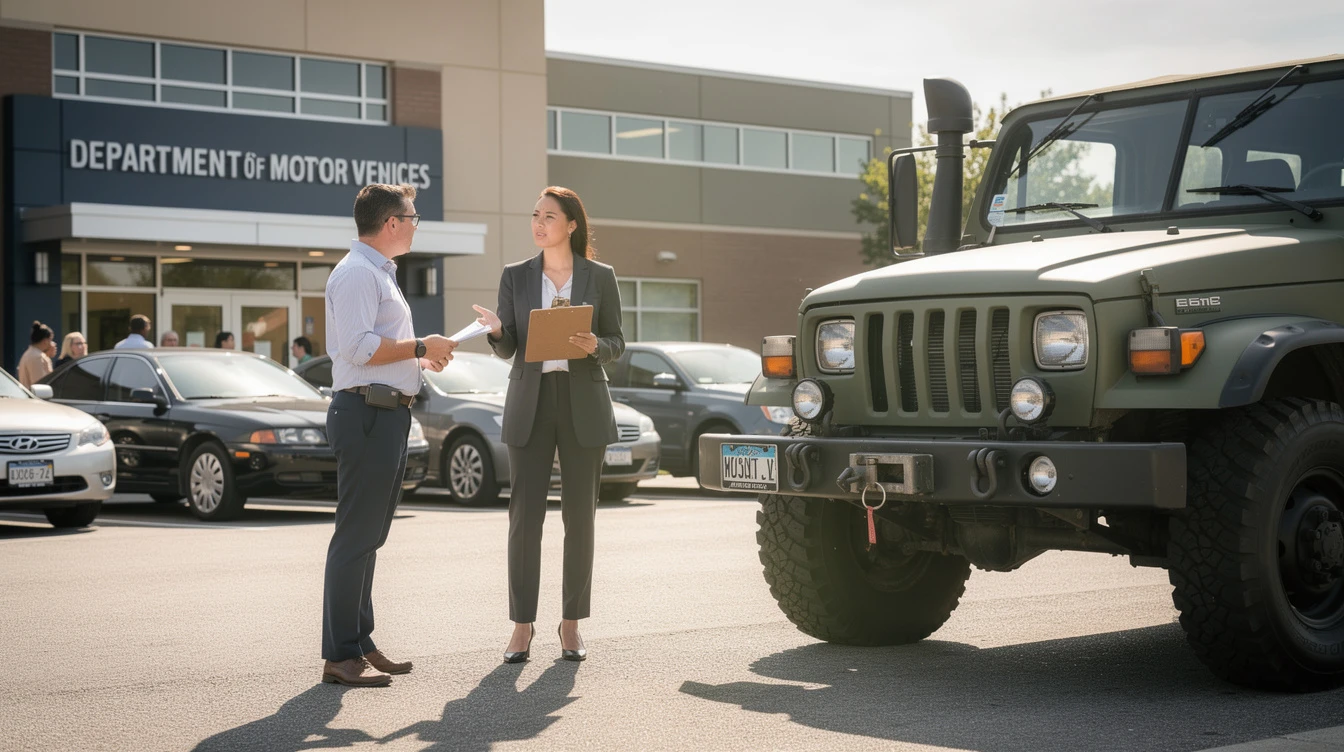
Registering a military vehicle for road use is a multi-step process that most DMVs are not set up to handle smoothly. You need to prove lawful civilian ownership (usually with an SF-97), get the vehicle titled in a state, install street legal equipment, pass safety inspections, and then register and insure the vehicle — all before you can drive it on a public road.
The process is not impossible, but it requires patience, the right documentation, and often a state that is friendly to military surplus vehicles. Here is the complete path from surplus purchase to street-legal plates.
The Five Stages of Military Vehicle Road Registration
| Stage | What Happens | Typical Timeline |
|---|---|---|
| 1. Ownership Documentation | Obtain SF-97, DD-1348, bill of sale | At purchase |
| 2. Titling | Get a state title issued in your name or LLC | 2–6 weeks |
| 3. Street Legal Conversion | Install DOT lights, signals, mirrors, horn | 1–4 weeks (parts + labor) |
| 4. Inspection | Pass state safety and/or emissions inspection | 1 day (if vehicle passes) |
| 5. Registration + Insurance | Get plates, tags, and liability coverage | Same day to 2 weeks |
Stage 1: Proving Ownership
Before any state will title your military vehicle, you need to prove you lawfully own it. The key documents:
- SF-97 (Certificate of Release): The gold standard. This federal form proves the vehicle was officially released from military service for civilian ownership. Most government auction purchases (GovPlanet, DRMS) include an SF-97.
- DD-1348 (Issue Release/Receipt): Often accompanies the SF-97. Some states accept it as primary ownership proof; others require the SF-97 specifically.
- Bill of Sale: For private-party purchases from someone who already owned the vehicle as a civilian.
If you are buying at auction, make sure the listing specifies that ownership documents are included. Vehicles sold "as-is, no documentation" are significantly harder to title. See our auction registration guide for what to expect from the purchase process.
Stage 2: Getting a State Title
Titling is where most military vehicle owners hit their first wall. The process depends on your state:
Friendly States
States like Montana, South Dakota, and Vermont have straightforward processes for titling military surplus vehicles. Montana in particular is popular because:
- No safety inspection required for titling
- No emissions testing
- LLC titling available (privacy + multi-state flexibility)
- Permanent registration available (no annual renewal)
- Low fees ($5 duplicate title, $87–$217 registration)
Moderate States
States like Texas, Florida, and Arizona will title military vehicles but may require VIN inspections, specific forms for non-standard vehicles, and additional documentation beyond the SF-97.
Difficult States
States like California, New York, and New Jersey have stricter requirements — emissions compliance, detailed safety inspections, and classification rules that can make military vehicle titling a multi-month process. Many owners in these states choose to title through a Montana LLC instead.
Our state-by-state ranking breaks down which states are most and least accommodating.
Stage 3: Street Legal Conversion
Military vehicles come from the factory configured for military use — not civilian road use. To make them street legal, you need to add or replace equipment to meet DOT (Department of Transportation) standards.
Required Equipment for Most States
- DOT headlights (high and low beam): Military blackout lights and convoy lights are not DOT-compliant. You need standard automotive headlights that meet FMVSS 108.
- DOT taillights and brake lights: Must be visible from 500+ feet. Military blackout taillights do not qualify.
- Turn signals (front and rear): Not installed on most military vehicles from the factory. Aftermarket kits are available specifically for HMMWVs.
- Horn: Audible at 200 feet. Military horns usually qualify, but verify it works.
- Mirrors: At minimum one rearview mirror. Most states require at least one side mirror as well.
- Windshield: Required in most states. Must be DOT-stamped safety glass.
- Windshield wipers: If a windshield is installed, wipers are required.
- Seat belts: Required in states that mandate them. Most HMMWVs have military lap belts that may or may not meet DOT standards.
For a detailed equipment list and installation guidance, see our HMMWV street legal conversion guide. The equipment requirements guide covers all military vehicle types beyond just HMMWVs.
Cost of Street Legal Conversion
Budget $500–$3,000 depending on the vehicle's starting condition and your state's requirements:
- Basic conversion (lights, signals, mirrors, horn): $500–$1,200 in parts for a HMMWV
- Full conversion (add windshield, wipers, seat belts, speedometer): $1,500–$3,000+
- Professional installation: Add $300–$800 for labor if you are not doing it yourself
Stage 4: Inspections
Many states require one or both of these inspections before registering a vehicle for road use:
Safety Inspection
A safety inspection verifies that your street legal conversion meets DOT standards. The inspector checks every item on the state's inspection checklist — lights, signals, brakes, steering, tires, horn, mirrors, glass, and seat belts. If you have done the conversion correctly, the vehicle should pass. If it fails, you get a report listing the deficiencies and a grace period to fix them.
VIN Inspection
Required in most states when titling a vehicle for the first time or from out of state. A law enforcement officer or DMV inspector physically examines the vehicle's serial number plate and verifies it matches the documentation. For military vehicles, the serial number is typically on the data plate — make sure it is legible and accessible.
Emissions Inspection
Most military vehicles are exempt from emissions testing due to age (25+ years old in most states) or diesel engine type. However, verify your state's specific exemptions before assuming. See our emissions requirements guide for state-specific rules.
Stage 5: Registration and Insurance
With a clean title, passed inspections, and street legal equipment installed, you can register the vehicle:
- Obtain insurance first. Most states require proof of insurance before issuing registration. Military vehicle insurance requires a specialty insurer in most cases.
- Complete the registration application at your DMV with the title, insurance proof, and inspection reports.
- Pay registration fees — varies by state ($15–$300 annually).
- Receive plates and registration card. Some states issue plates immediately; others mail them within 1–2 weeks. Temporary tags may be available for the interim.
Timeline: How Long Does the Whole Process Take?
Realistic timelines for the full process from purchase to plates:
- Best case (friendly state, complete documentation, DIY conversion): 4–6 weeks
- Typical case (moderate state, standard documentation, some conversion needed): 6–12 weeks
- Worst case (difficult state, missing documentation, extensive conversion): 3–6+ months
Using a registration assistance provider like HMMWV Registration can significantly shorten the timeline by handling the paperwork, identifying the best titling state, and coordinating documentation before you start the process.
Frequently Asked Questions
Can any military vehicle be registered for road use?
Most can, but not all. Vehicles that can be made to meet DOT safety standards (headlights, signals, brakes, mirrors) can generally be registered. Vehicles that are too wide, too heavy, or cannot accommodate required safety equipment may be restricted to off-road use in some states. HMMWVs, M35 Deuce and a Halfs, and similar vehicles are regularly registered for road use.
Do I need to convert my military vehicle before titling it?
No — titling and street legal conversion are separate steps. You can title the vehicle first (proving ownership) and then do the street legal conversion before registration. In fact, this is the recommended order because you need a title to get insurance, and you need insurance to register.
How much does it cost to register a military vehicle for road use?
Total costs from purchase to plates typically range from $1,000–$5,000 including: titling fees ($50–$200), street legal conversion parts and labor ($500–$3,000), inspection fees ($25–$100), registration fees ($15–$300), and insurance (first payment). The vehicle purchase price is separate.
Can I register a military vehicle in a state where I do not live?
Yes, through an LLC. Many military vehicle owners form a Montana LLC and title the vehicle through the LLC. The vehicle is registered in Montana regardless of where the owner physically resides. This is a common and well-established practice for military surplus vehicles.
What if my military vehicle fails the safety inspection?
You receive a report listing specific deficiencies. Most states give you 15–30 days to correct the issues and bring the vehicle back for re-inspection. Common failure points on military vehicles include non-DOT headlights, missing turn signals, and non-functional windshield wipers. All are fixable with aftermarket parts.