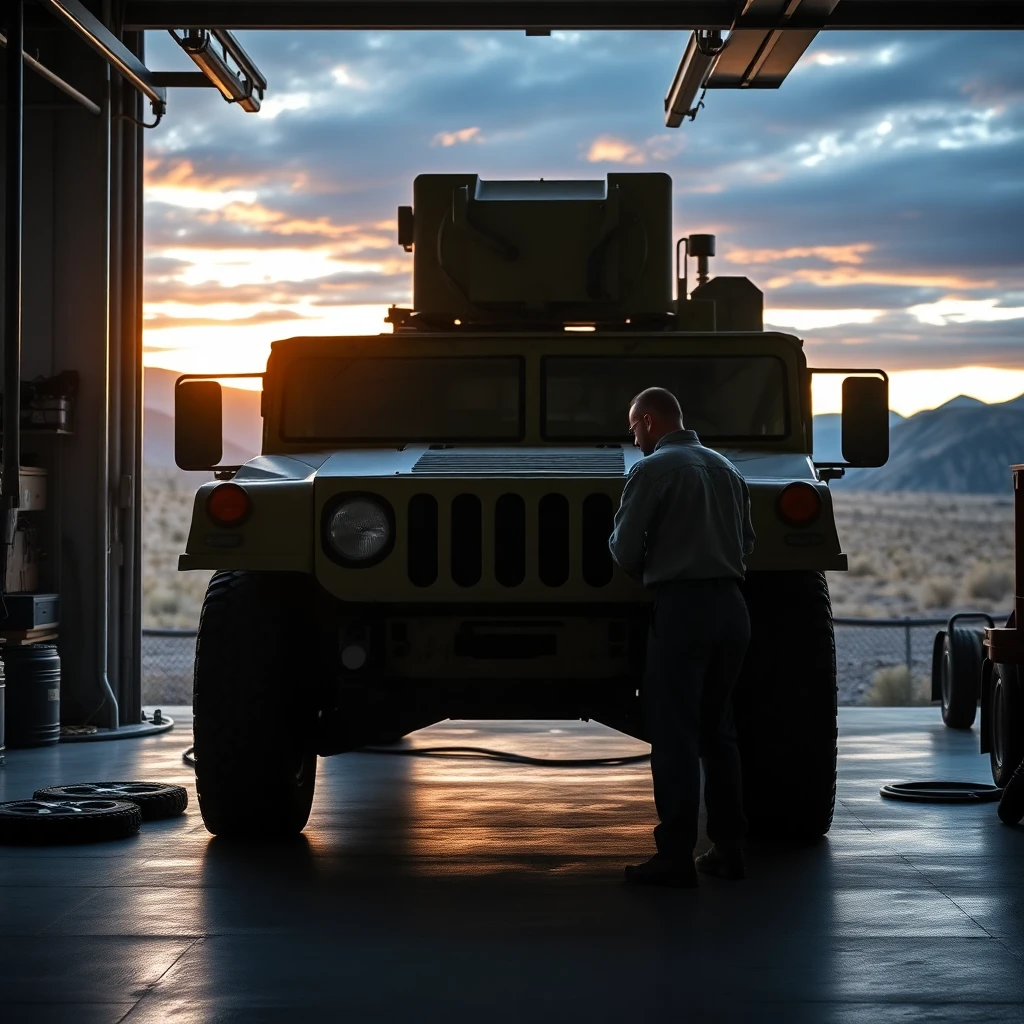
VIN verification for a military vehicle is not the same as a standard vehicle inspection at a dealer. Military HMMWVs, deuce-and-a-half trucks, M939 5-tons, and other surplus vehicles use identification systems developed by the Department of Defense, not the civilian 17-digit VIN format. Before any state DMV or Montana MVD will issue a civilian title, an authorized inspector must physically examine the vehicle, confirm the identification number stamped on it matches the transfer documents, and sign the VIN inspection form. This guide answers every question operators run into during that process.
Already have your VIN inspection done? We handle the Montana title and registration from there, any state, fully remote.
Start Registration →What Is a Military Vehicle VIN?
The civilian VIN (Vehicle Identification Number) is a standardized 17-character alphanumeric code established by the National Highway Traffic Safety Administration (NHTSA) under Federal Motor Vehicle Safety Standard 115. It encodes the manufacturer, country of origin, vehicle type, model year, and serial number in a specific sequence.
Military vehicles do not follow this standard. The Department of Defense uses a registration system built around the National Stock Number (NSN) and the Unit Identification Code (UIC). These are logistics and inventory numbers, not civilian title identifiers. An HMMWV's data plate typically shows a Registration Number or Serial Number assigned at the manufacturing level, a Contract Number from the procurement contract, and a National Stock Number that identifies the vehicle type within the DoD inventory system.
When an HMMWV moves into civilian ownership, the Registration Number on the data plate becomes the number that civilian DMVs and Montana MVD use as the VIN for title and registration purposes. This number is what the inspector verifies, and it is what appears on the SF-97 as the vehicle identifier.
Where Is the VIN on an HMMWV?
The data plate carrying the vehicle identification information is located in different positions depending on the HMMWV variant and production year. Inspectors need to know where to look.
M998 and M998A1 (1984 to 1993 production)
The data plate is attached to the instrument panel on the driver's side, typically on the upper dash near the steering column. The plate is aluminum and lists the NSN, Registration Number, Contract Number, and model designation. Some early M998 units have the plate on the driver's side door jamb frame.
M1097 and M1097A1/A2 (1993 to 2007 production)
The data plate is located on the driver's side door jamb, inward-facing when the door is open. The M1097 series also has a secondary data stamp on the vehicle frame rail on the driver's side, near the front axle. Inspectors should verify both when present.
M1025, M1026, M1035 (armed/shelter variants)
These mission-specific variants follow the same data plate location as the base M998 series they are built on, with additional plates installed for mission equipment. The primary registration number is on the main body data plate, not on any mission equipment plates.
M1113, M1114, M1151, M1152 (ECV series, 2001 and later)
The Enhanced Capability Vehicle series carries the data plate in the driver's door jamb and has a second stamped number in the frame. The ECV series also began incorporating a 17-digit number format closer to civilian VIN standards for later production years, which simplifies the inspection form.
M35 Deuce-and-a-Half and M939 5-Ton Trucks
On medium and heavy military trucks, the data plate is typically on the firewall on the driver's side, visible when the hood is open. A secondary stamp is often on the frame rail near the front crossmember. These vehicles have been in the surplus market since the 1980s and inspectors in high-military-surplus states (Texas, Florida, Montana) are familiar with the location.
Who Can Perform a Military Vehicle VIN Inspection?
Each state defines who is authorized to perform VIN inspections. The common options are:
Law Enforcement Officers
A sworn officer from any local, county, or state law enforcement agency can perform a VIN inspection in most states. This is the most accessible option in rural areas. The officer compares the number on the vehicle to the SF-97, fills out the state VIN inspection form, and signs it. There is typically no fee. Call your local police department or sheriff's office to ask about the process before showing up. Some departments have a designated VIN inspection officer; others will accommodate a walk-in request.
Licensed Vehicle Dealers
A licensed motor vehicle dealer can perform VIN inspections in most states. Dealers charge a nominal fee, typically $25 to $75. This is useful when law enforcement is not available or when you need the inspection done quickly during business hours. Some dealers are unfamiliar with military data plates, so confirm they have done surplus vehicle inspections before scheduling.
State-Authorized Inspectors
Several states have a formal VIN inspection station network. California requires a DMV-authorized VIN verifier. New York requires a state-certified VIN inspector. In these states, the inspection must be done at or by a specific licensed station, not by a general law enforcement officer. Check your state's DMV website for the specific requirement before scheduling.
Montana MVD Acceptance of Out-of-State Inspections
This is one of Montana's most operator-friendly policies: Montana accepts a VIN inspection completed in any US state. You do not need to transport the vehicle to Montana for inspection. A VIN inspection done by a local sheriff's deputy in Alabama is valid for a Montana title application. The inspection form just needs to be completed and signed by an authorized inspector in whichever state the vehicle is physically located.
What the VIN Inspection Form Requires
State VIN inspection forms vary but all require the same core information. Make sure the inspector captures all of it at time of inspection:
- Vehicle Identification Number exactly as stamped on the data plate
- Make (for HMMWVs: AM General)
- Model (M998, M1097, M1025, or the specific variant)
- Model year (found on the data plate or derivable from the contract number)
- Body type (truck/utility or the applicable civilian category)
- Inspector's name, badge number or license number, and signature
- Date of inspection
- Vehicle location at time of inspection
The form also needs to reference the SF-97 as the title document. Some states have a specific field for this; on others you write it in the notes. Make sure the number on the inspection form matches the number on the SF-97 exactly, including any leading zeros or prefix characters. A mismatch between these two documents is the most common reason for a title application rejection.
What to Do If the Data Plate Is Missing or Damaged
Military vehicles that have passed through multiple owners, been through battlefield recovery, or were stored improperly sometimes have damaged, illegible, or missing data plates. This is a more common problem than people expect and there are several resolution paths.
Frame Stamp as Alternative
Many HMMWVs have a secondary identification number stamped directly into the frame rail. If the data plate is missing but the frame stamp is legible, the inspector can use the frame stamp number on the VIN inspection form. Note on the form that the identification was confirmed from the frame stamp rather than the data plate, and explain why the data plate was not available.
Contacting the Releasing Activity
If neither the data plate nor the frame stamp is legible, contact the original releasing activity listed on the SF-97. The Defense Logistics Agency (DLA) maintains records of every government vehicle disposed of through DLA Disposition Services. With the contract number and NSN from the SF-97, DLA can often provide a confirmation letter with the vehicle's registered identification number. This letter, combined with whatever partial identification is visible on the vehicle, is often sufficient for Montana MVD to proceed.
Bonded Title Process
When identification cannot be confirmed through any of the above methods, some states offer a bonded title process. You purchase a surety bond for the vehicle's declared value, wait out a statutory period (typically 1 to 3 years depending on state), and the bond converts to a clean title if no prior owner claims emerge. This process runs 30 to 90 days minimum and adds bond fees. It is the fallback, not the first option.
Montana's Approach to Incomplete Identification
Montana MVD has processed incomplete-identification cases for military surplus vehicles for decades. Their guidance is: provide as much identifying information as you have, explain the gap in writing, and submit the best available documentation including the SF-97, any partial frame stamp legibility, and any DLA correspondence. Montana takes a practical approach and processes a higher percentage of these cases successfully than most state DMVs.
VIN Verification for Specific Military Vehicle Types
M151 MUTT (1/4-Ton Utility Tactical Truck)
The M151 series is subject to a federal demilitarization order for safety reasons. Most M151s were demilitarized (cut in half) before surplus release. Registration of an intact M151 requires careful review of the DEMIL code on the SF-97. Code Q with a verified civilian release is the only path to registration. Many states and Montana have processed M151 registrations successfully, but the document review takes longer than standard HMMWV cases.
LSSV (Light Service Support Vehicle)
The LSSV is a militarized version of the Chevrolet Silverado K3500 4x4. It carries a standard 17-digit civilian VIN in addition to the NSN data plate because it was built on a commercial chassis. VIN verification for an LSSV uses the civilian 17-digit VIN, not the military data plate number. This makes the inspection process significantly simpler than for purpose-built military platforms like the HMMWV.
M35 and M939 Series Trucks
Medium tactical trucks have been circulating in the civilian surplus market since the 1980s. The inspection process is well-established in most states. Data plates are typically accessible without tools, on the driver's side firewall. Frame stamps are common. These vehicles register under commercial truck categories in most states, which can affect registration fees and weight-class determinations.
Military Trailers
Military trailers carry their own NSN data plates and have their own VIN verification requirements separate from the towing vehicle. If you are registering a trailer along with an HMMWV, schedule separate inspections for each unit. Montana registers trailers under the same LLC as the towing vehicle with a separate title and registration document for each.
State-Specific VIN Inspection Notes
Most states accept a standard law enforcement VIN inspection. These states have specific requirements worth knowing:
- California: Requires a DMV-authorized VIN verifier (REG 31 form). Law enforcement inspections are not accepted. Schedule through the DMV directly or use an approved verifier service.
- New York: Requires a state-certified VIN inspection station. The inspection must include a Form MV-82 and a VIN verification form. Certified stations are listed on the NY DMV website.
- Texas: Requires the inspection to be done by a licensed dealer, law enforcement, or a Texas DPS officer. The inspection form is the TxDMV VTR-270.
- Florida: Accepts law enforcement or licensed dealer inspections. The Florida HSMV 82042 form is used. Florida also accepts inspections done in other states if the vehicle is being brought into Florida for first registration.
- Montana: Accepts inspections done in any state by law enforcement, licensed dealers, or authorized inspectors. The Montana MVD VIN inspection form is included in the title application packet.
Common Mistakes That Cause VIN Inspection Rejections
- Number mismatch between form and SF-97: Even a single digit difference causes rejection. Confirm the number character by character against the SF-97 before submitting.
- Inspector uses wrong form: Some inspectors use a generic form when the state requires a specific form. Confirm the required form number before the inspection appointment.
- Model year left blank: Military vehicles sometimes do not have the model year in an obvious location on the data plate. The model year can often be derived from the contract number or established through the NSN. Do not leave this blank on the form.
- Body type field filled incorrectly: An HMMWV should generally be classified as a utility truck or light truck, not as a passenger vehicle or SUV, depending on the state's vehicle classification scheme. Misclassification can affect fees and sometimes causes the application to be flagged for review.
- Inspector signs but does not include credentials: The form needs the inspector's badge number (for law enforcement) or dealer license number. A signature without credentials is not sufficient for Montana MVD or most state DMVs.
Cost and Timeline
Law enforcement inspections are typically free or $10 to $25 for administrative processing. Licensed dealer inspections run $25 to $75. State-specific inspection stations (California, New York) may charge $50 to $100. The inspection itself takes 15 to 30 minutes once the inspector arrives or you arrive at the station.
Allow 1 to 3 business days to schedule a law enforcement inspection depending on your location and the department's availability. Urban areas often have dedicated VIN inspection services available same-day. Rural areas may require scheduling 1 to 2 weeks out. Licensed dealers are usually available within a few business days.
Frequently Asked Questions
Does my HMMWV need a VIN inspection even if it came with an SF-97?
Yes, in most cases. The SF-97 is the title document, but the VIN inspection confirms that the vehicle physically present matches the vehicle described in that document. It is a chain-of-custody check. Montana requires it. Most state DMVs require it. The VIN inspection form is submitted along with the SF-97 and the title application as a package.
Can I do the VIN inspection before I decide on my registration state?
Yes, and it is often a good idea. The VIN inspection form is a document that describes the vehicle. It gets submitted to whatever state or entity processes your title. Getting the inspection done before you finalize your registration path means you have one less step to coordinate later. Montana accepts inspections done well in advance of the title application as long as the form is complete and signed.
My HMMWV was bought from a private seller, not GovPlanet. Does that change the VIN inspection process?
No. The inspection process is the same regardless of where the vehicle was acquired. The inspector examines the vehicle that is physically in front of them and confirms the number on it matches the SF-97 you provide. Whether the SF-97 was issued to you directly or to a prior owner who then sold to you does not affect the inspection. The title chain documentation is a separate question from the inspection.
The inspector says they have never inspected a military vehicle before. Is that a problem?
It can slow things down. Most law enforcement officers have never done this and will need a few minutes to locate the data plate and understand what they are looking at. Bring a printed copy of the data plate location diagram for your specific variant. Have the SF-97 ready showing exactly which number needs to be confirmed. Walk the inspector through it. The inspection is straightforward once the inspector understands what they are comparing. If an officer is unwilling to do the inspection, try a licensed dealer instead.
Can I get a VIN inspection if my HMMWV is not currently operable?
Yes. The inspection is of the static vehicle, not a driving test. The inspector needs to physically access the data plate and frame stamp location. As long as the vehicle is accessible and the identification numbers are legible, operability is not a requirement for VIN inspection.
How long is a completed VIN inspection valid?
Most states and Montana do not publish a specific expiration for the VIN inspection form. In practice, forms more than 6 to 12 months old may prompt questions from the DMV. If significant time has passed between the inspection and your title application, you may want to get a fresh inspection to avoid any processing delays. When using a registration service like ours, we will tell you if your inspection form needs to be refreshed before submission.
VIN inspection done. What next? We handle Montana LLC formation, title application, and plate delivery from any US state.
Get a Free Quote →