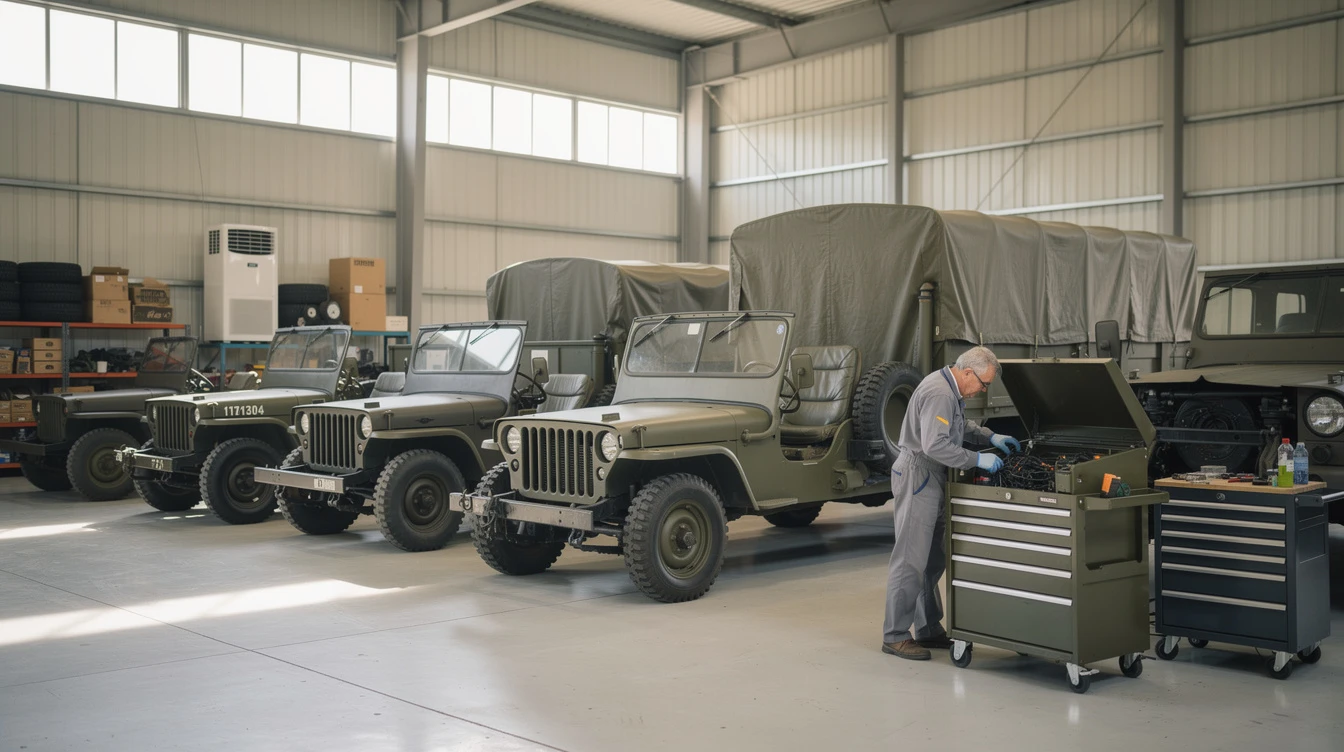
A well-maintained military vehicle collection is one of the few automotive investments that can actually appreciate. While a new truck loses 30% in three years, a properly documented HMMWV or M35 Deuce and a Half can gain 5–15% annually as supply shrinks and collector demand grows. But "properly maintained" is doing a lot of heavy lifting in that sentence — the difference between a collection that appreciates and one that rusts into scrap comes down to storage, documentation, maintenance, and market awareness.
Here is what separates collectors who build wealth from those who build expensive problems.
The Five Pillars of Collection Value
| Pillar | Impact on Value | Neglect Cost |
|---|---|---|
| Storage | Prevents physical deterioration | Rust, rodent damage, UV degradation — 20–50% value loss |
| Documentation | Proves provenance and ownership chain | Missing docs reduce value 15–30% |
| Maintenance | Keeps vehicles operational and prevents cascading failures | Deferred maintenance compounds exponentially |
| Authenticity | Original-spec vehicles command highest premiums | Incorrect parts or modifications reduce collector value |
| Registration & Title | Street-legal vehicles sell for more than non-titled ones | Untitled vehicles sell at 30–50% discount |
Storage: The Foundation of Preservation
Indoor Storage (Ideal)
Climate-controlled indoor storage is the gold standard for military vehicle preservation. The key factors:
- Temperature stability: Wide temperature swings cause condensation inside engines, transmissions, and fuel tanks. Condensation causes internal corrosion that you cannot see until it causes failure. Maintain 40–80°F if possible.
- Humidity control: Target 40–50% relative humidity. Below 30% dries rubber seals and tires. Above 60% accelerates rust and mold growth on canvas and upholstery.
- Concrete floor: Vehicles stored on dirt or gravel absorb ground moisture through the frame and body. A sealed concrete floor with a vapor barrier is the minimum acceptable surface.
- Rodent prevention: Military vehicles have extensive wiring harnesses, rubber hoses, and canvas components that rodents love. Steel wool in exhaust pipes, mothballs around the perimeter, and electronic repellers are standard precautions.
Covered Outdoor Storage (Acceptable)
If indoor storage is not available for every vehicle in the collection, covered outdoor storage (carport, lean-to, or quality vehicle cover) is the minimum acceptable protection:
- Use breathable covers — non-breathable covers trap moisture and accelerate rust
- Elevate the vehicle on jack stands or blocks to prevent flat-spotting tires and allow airflow under the chassis
- Remove the battery and store it on a trickle charger indoors
- Seal all openings (exhaust, air intake, cab vents) against rodent intrusion
Open-Air Storage (Destructive)
Military vehicles are tough, but they are not immune to the elements. A HMMWV left uncovered in a field for 5 years will lose most of its collector value to surface rust, seized components, and deteriorated seals. If you own vehicles you cannot store properly, it is better to sell them to someone who can than to watch them deteriorate.
Documentation: Provenance Is Money
In the military vehicle collector market, documentation adds tangible value. A HMMWV with a complete ownership chain — SF-97, original auction receipt, every bill of sale, maintenance records, and restoration photos — sells for 15–30% more than an identical vehicle with no paperwork.
What Documentation Adds the Most Value
- Military service history: Unit assignment, deployment history, and operational role. Vehicles with verifiable combat deployment history command the highest premiums.
- SF-97 and DD-1348: Original government release documents proving lawful civilian ownership. For detailed guidance, see our records management guide.
- Restoration documentation: Before/after photographs, parts lists with sources, and work logs showing exactly what was done. Our restoration documentation guide covers best practices.
- Professional appraisals: Annual appraisals establish fair market value for insurance, estate planning, and eventual sale. They also create a historical record of the vehicle's appreciation.
Maintenance for Non-Daily Drivers
Collection vehicles that sit for months between drives require different maintenance than daily drivers. The biggest threats to stored vehicles are not wear — they are corrosion, seal degradation, and fluid deterioration.
Monthly Tasks (Even for Stored Vehicles)
- Start and run the engine to operating temperature (not just a few minutes — 15+ minutes minimum). This cycles oil through the system, evaporates condensation, and lubricates seals.
- Cycle all controls: Steering, brakes, clutch, transmission, transfer case. Seals that sit in one position for months develop flat spots and leak.
- Check tire pressure. Stored vehicles lose 1–2 PSI per month. Under-inflated tires develop flat spots that may be permanent after extended storage.
- Inspect for rodent activity. Check under the hood, inside the cab, and around wiring harnesses.
Seasonal Tasks
- Change oil and filter at least annually, even if the vehicle has not been driven. Oil absorbs moisture and acids over time that corrode bearings and journals.
- Replace fuel with fresh fuel or add a fuel stabilizer. Diesel fuel degrades after 6–12 months and can grow algae that clogs injectors and fuel lines.
- Flush coolant every 2 years. Corrosion inhibitors in coolant deplete over time regardless of usage.
- Exercise the CTIS system (on HMMWVs) to keep seals flexible and the compressor operational.
- Inspect brake fluid. Brake fluid is hygroscopic — it absorbs moisture from the air, which lowers its boiling point and causes internal corrosion in brake components.
Authenticity and Originality
The military vehicle collector market splits into two camps: original/preserved and restored/modified. Both have value, but they appeal to different buyers:
Original/Preserved (Highest Collector Value)
Vehicles in original military configuration with genuine military parts command the highest prices. Collectors in this camp want:
- Original military paint (even if faded or chipped)
- Genuine military-issue components (not aftermarket reproductions)
- Original data plates, instruction placards, and markings
- Military accessories (pioneer tools, fire extinguisher, first aid kit) in original locations
An original, unrestored M998 HMMWV with matching data plate and low miles can sell for $30,000–$50,000+ to the right collector — significantly more than a restored example.
Restored (Strong Market Value)
Properly restored vehicles have strong market value when the restoration uses correct military-specification parts and follows technical manual procedures. The key is correctness — a HMMWV restored with incorrect civilian parts (wrong headlights, non-military seats, automotive paint instead of CARC) loses value compared to one restored with genuine or correctly reproduced military parts.
Modified (Reduced Collector Value)
Heavily modified military vehicles (civilian engine swaps, lifted suspensions, custom paint, non-military accessories) have reduced collector value. They appeal to a different market — the enthusiast/weekend driver market rather than the collector/investment market. If you plan to modify a vehicle, choose the least original or most common example in your collection, not the most rare.
Registration and Title Status
Titled, registered, street-legal military vehicles sell for significantly more than untitled or off-road-only vehicles. The reasons:
- Buyer convenience: A titled vehicle can be driven home and insured immediately. An untitled vehicle requires the buyer to go through the titling process themselves.
- Proof of legality: A state title proves the vehicle was lawfully acquired. Untitled military vehicles create anxiety about their legal status.
- Insurance availability: Agreed-value collector insurance requires a title. Untitled vehicles are much harder to insure.
If you have untitled vehicles in your collection, consider titling them now while you have the documentation. The cost of titling ($50–$200 per vehicle) is trivial compared to the value increase. See our registration guide for the process.
Insurance for Collections
Collection insurance is different from individual vehicle insurance. Key considerations:
- Agreed-value policies: Lock in the insured value at a specific amount based on your appraisal. Standard actual-cash-value policies use depreciation tables that dramatically undervalue military vehicles.
- Collection discounts: Insurers like Hagerty and American Collectors offer multi-vehicle discounts when insuring a collection. 3+ vehicles typically qualify.
- Storage coverage: Verify your policy covers vehicles in storage, not just vehicles being driven. Some policies have different coverage levels for stored vs. active vehicles.
- Transit coverage: If you move vehicles between storage locations, shows, or events, verify the policy covers transit. Towing and trailering are not always included.
For detailed insurance guidance, see our military vehicle insurance guide.
Market Awareness
Understanding the market helps you make better decisions about which vehicles to acquire, maintain, and eventually sell:
- Track auction prices: Follow GovPlanet, Bring a Trailer, and eBay completed listings for your vehicle types. Understanding current market values helps you identify undervalued acquisition opportunities and correctly price eventual sales.
- Join the community: Forums like r/HMMWV, the Steel Soldiers forum, and MVPA (Military Vehicle Preservation Association) connect you with other collectors, parts sources, and market intelligence.
- Attend shows: MVPA conventions, military vehicle shows, and reenactment events expose your collection to potential buyers and connect you with dealers who specialize in military vehicles.
Frequently Asked Questions
Do military vehicles appreciate in value?
Well-maintained, properly documented military vehicles have appreciated 5–15% annually over the past decade as supply of surplus vehicles decreases and collector demand grows. Rare variants (M1114 up-armored, early M998s, low-production models) appreciate faster than common variants.
What is the biggest threat to stored military vehicles?
Moisture. Condensation inside engines causes internal corrosion. Ground moisture rots frames from below. Humidity grows mold on canvas and upholstery. Climate-controlled indoor storage or at minimum covered storage with moisture barriers is the most important investment you can make.
Should I restore a military vehicle or leave it original?
It depends on the vehicle's current condition and rarity. For rare, low-production vehicles in reasonable original condition, preservation (not restoration) protects the highest value. For common variants in poor condition, a correct restoration adds value. Never restore a vehicle with incorrect parts — that reduces value below both original and correctly restored examples.
How often should I get my military vehicle appraised?
Annually for insurance purposes and any time you make significant improvements (restoration, street legal conversion). Appraisals from recognized military vehicle appraisers carry more weight than generic auto appraisals. Keep every appraisal in your vehicle's documentation file.
Does having a street-legal title increase value?
Significantly. Titled, registered vehicles sell for 30–50% more than untitled equivalents. The title proves lawful ownership, allows the buyer to drive and insure the vehicle immediately, and eliminates the risk and expense of the titling process.