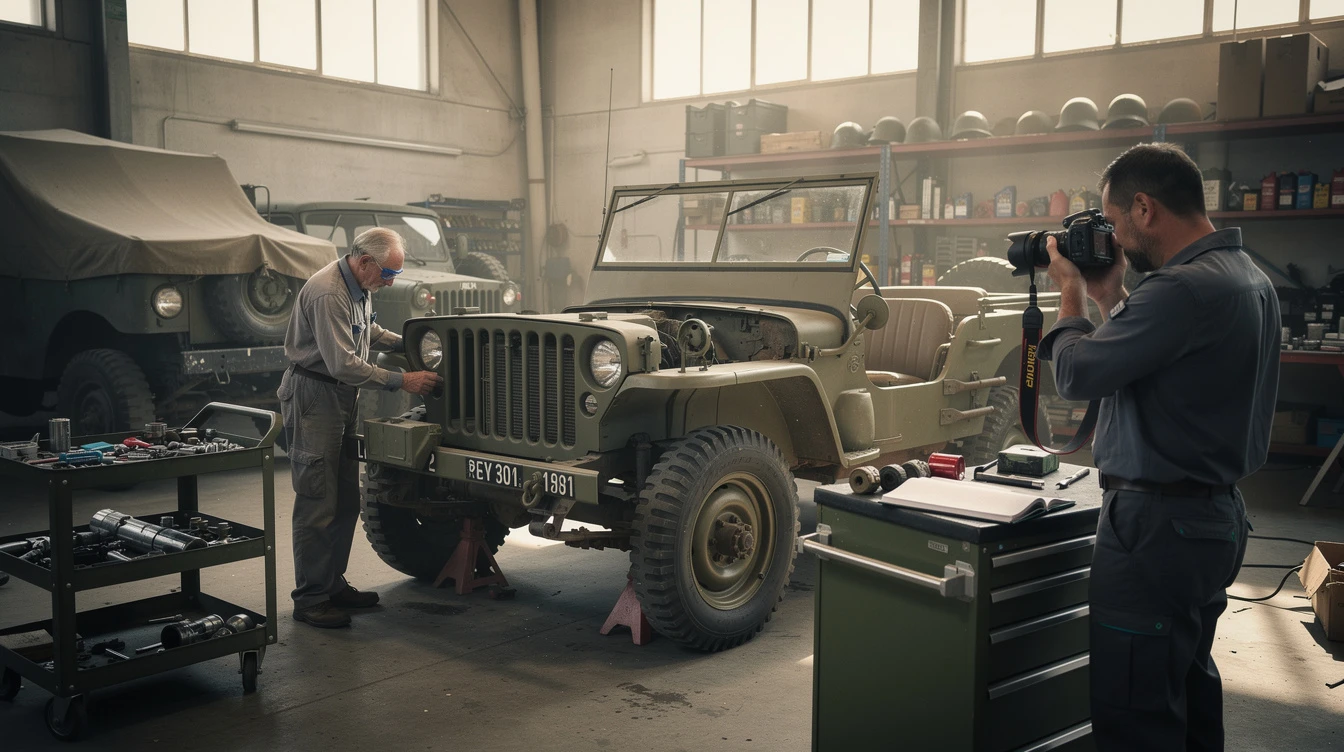
Why Restoration Documentation Matters More Than Most Owners Realize
A military vehicle restoration is a significant investment of time, money, and mechanical skill. Whether you are rebuilding an M998 HMMWV picked up at a GovPlanet auction or bringing an M35 deuce-and-a-half back to running condition, the documentation you create during the process directly affects your ability to title the vehicle, insure it at full value, and sell it down the road without losing money.
Most surplus military vehicles arrive without the kind of paper trail that a civilian car carries from the factory. There is no Carfax report. There is no dealer service history. The documentation starts with you, and what you record during the restoration becomes the permanent record of that vehicle for every future owner.
This guide breaks down exactly what to document, how to organize it, and which records matter most for titling, insurance, and resale in 2026.
The Five Categories of Restoration Documentation
Every military vehicle restoration binder should be divided into five clear sections. Each one serves a different audience — DMV clerks, insurance adjusters, potential buyers, and your own future self when you need to remember what torque spec you used on the transfer case bolts three years ago.
| Section | What Goes Here | Who Needs It |
|---|---|---|
| Acquisition | SF-97, bill of sale, auction receipt, shipping docs | DMV, title company |
| Identity | VIN photos, data plate images, DD-1348, serial number log | DMV, VIN inspector |
| Mechanical | Parts receipts, labor invoices, fluid change logs, torque records | Insurance adjuster, buyer |
| Safety & Compliance | Inspection reports, lighting test results, brake certifications | State inspector, DMV |
| Insurance & Valuation | Appraisals, agreed-value policy, photo timeline, total cost summary | Insurance company, buyer |
If you are still building your ownership paper trail, our guide on what records to keep for military vehicle ownership covers the full list of documents every surplus vehicle owner should maintain.
Acquisition Documents: The Foundation of Your Paper Trail
Before you turn a single wrench, the acquisition paperwork establishes that you own the vehicle and that it was released from government service through proper channels.
The SF-97: Your Most Important Single Document
The SF-97 (Certificate of Release of a Motor Vehicle) is the federal form that proves the U.S. government sold a surplus vehicle to a civilian buyer. Most state DMVs require an SF-97 or its equivalent before they will issue a title for a former military vehicle.
Store the original SF-97 in a fireproof container. Make at least three certified copies. Digital scans are useful for quick reference, but many state agencies still require a physical original during the title application. For a deep dive into how this form works in the titling process, read our SF-97 form military vehicle documentation guide.
Bill of Sale and Auction Records
If you purchased from GovPlanet, IronPlanet, or a private seller, keep the complete bill of sale showing the purchase price, date, seller information, and vehicle description. Auction confirmation emails and payment receipts count as supporting evidence if the bill of sale is ever questioned.
Owners who bought through GovPlanet can reference our GovPlanet HMMWV auction to Montana plates walkthrough for the full process from winning bid to titled vehicle.
DD-1348 and Other Military Transfer Forms
The DD-1348 (DoD Single Line Item Release/Receipt Document) details the equipment specifications and condition at the time of government release. Not every surplus vehicle comes with one, but if yours did, it adds a layer of provenance that insurance companies and collectors value highly. See our comparison of DD-1348 vs SF-97 documents for when each form applies.
Photographing Your Restoration: What to Shoot and When
Photography is the single most underrated form of restoration documentation. A complete photo record does three things that paper alone cannot: it proves the vehicle existed in a specific condition at a specific time, it shows the quality of workmanship to insurance appraisers, and it dramatically increases buyer confidence if you ever sell.
Pre-Restoration Condition Photos
Before you remove a single bolt, photograph the entire vehicle from every angle. Include close-ups of:
- The VIN plate and all data plates (legibility matters for title applications)
- Every body panel, showing rust, dents, and existing paint condition
- The engine bay, drivetrain, and undercarriage
- The interior, including dashboard gauges and seat frames
- Any military markings, unit insignia, or stenciled identification numbers
These baseline photos establish the starting point. Without them, an insurance company has no way to verify the scope of work you performed, which directly affects your agreed-value coverage amount.
During-Restoration Stage Photos
Photograph each major milestone during the build. At minimum, capture images at these stages:
| Stage | What to Capture | Why It Matters |
|---|---|---|
| Disassembly | Components as removed, labeled bags of hardware | Proves original condition of replaced parts |
| Frame & body work | Rust repair, welding, sandblasting, primer | Shows structural integrity was restored |
| Drivetrain rebuild | Engine, transmission, transfer case, axles | Validates mechanical investment for appraisal |
| Electrical system | Wiring harness, lighting, 24V to 12V conversion | Proves compliance-ready electrical work |
| Safety modifications | Headlights, turn signals, mirrors, seat belts | Required for street-legal inspection |
| Final assembly | Completed vehicle from all angles, running engine | Establishes finished condition for valuation |
Use a consistent background or location for your photos so that the progression is visually clear. Include a date card, newspaper, or phone timestamp in early shots to establish a timeline that holds up under scrutiny.
Mechanical Records: Tracking Every Part, Every Fluid, Every Torque Spec
A detailed mechanical log transforms your vehicle from "a restored HMMWV" into "a documented restoration with verified components." The difference can mean thousands of dollars in resale value and the gap between standard insurance coverage and an agreed-value policy.
Parts Receipts Organized by System
Sort every receipt into categories: drivetrain, electrical, body and frame, brakes and steering, cooling, and interior. For each part, record:
- Part number and description
- Supplier name and date of purchase
- Cost (including shipping)
- Whether the part is NOS (new old stock), aftermarket, or rebuilt
This level of detail matters because insurance adjusters use parts receipts to calculate replacement cost. If you spent $3,200 on a rebuilt 6.5L diesel engine and cannot prove it, your claim payout will reflect the value of whatever unknown engine the adjuster assumes is installed.
Labor and Service Logs
If you hired a shop for any portion of the work — frame welding, machine shop services, paint — keep the invoice with a description of what was done. If you did the work yourself, maintain a simple log with dates, tasks completed, and hours spent. Self-performed labor is not typically insurable, but it adds credibility to the overall restoration narrative.
Fluid Change and Maintenance Records
From the first oil fill to the final differential fluid top-off, record every fluid change with the date, mileage (or hour meter reading), product used, and quantity. This baseline maintenance record starts the vehicle's service history from day one of its civilian life.
Safety and Compliance Documentation
If your goal is to make the vehicle street-legal, your restoration documentation must include evidence that all required safety equipment was installed and tested. State requirements vary, but the core items are consistent across most jurisdictions.
What Safety Records to Keep
- Lighting: Receipts and installation photos for DOT-compliant headlights, tail lights, turn signals, and brake lights. Our guide on military vehicle safety requirements covers the full list.
- Mirrors: Documentation showing the size, placement, and mounting of side mirrors that meet state minimum visibility standards
- Brakes: Test results or shop certification that the braking system meets federal FMVSS standards, per NHTSA Federal Motor Vehicle Safety Standards
- Tires: Receipts showing DOT-rated tires with appropriate load ratings for the vehicle's GVWR
- Seat belts: Installation records if seat belts were added (many surplus HMMWVs shipped without them)
Keep copies of any state inspection reports. If your state requires a VIN inspection for out-of-state or specially constructed vehicles, that report goes in this section as well. See our VIN inspection state requirements guide for what to expect.
Need help with titling and registration?
HMMWV Registration handles the paperwork so you can focus on the build. We work with surplus vehicle owners across all 50 states.
Start Your Registration →Insurance and Valuation Records
Standard auto insurance policies value vehicles at market price, which does not account for the money you invested in a frame-off restoration. To get full coverage, you need an agreed-value policy — and to get an agreed-value policy, you need documentation.
How Documentation Affects Insurance Valuation
An insurance appraiser determining the value of a restored HMMWV will look at three things:
- Total parts investment: The sum of all receipts from your mechanical records section
- Photo evidence of quality: Stage-by-stage photos proving the work was done to a high standard
- Comparable sales: Recent auction results for similar vehicles in similar condition
Without parts receipts and photos, the appraiser has no basis to value your restoration above the market average for a "running" surplus HMMWV. That gap can be $15,000 to $40,000 depending on the scope of work performed. For more on coverage options, see our HMMWV insurance and military surplus vehicle guide.
Getting a Professional Appraisal
Once the restoration is complete, hire an appraiser who has experience with military surplus vehicles. Organizations like the Military Vehicle Preservation Association (MVPA) can connect you with qualified appraisers. Bring your complete binder to the appraisal — the more documentation you provide, the higher and more defensible the valuation.
Digital vs. Physical Records: Keep Both
The ideal setup is a physical binder with original documents stored in a fireproof container, plus a complete digital backup in cloud storage. Here is why both matter:
| Format | Advantage | Limitation |
|---|---|---|
| Physical originals | Required by many DMVs; accepted in court | Vulnerable to fire, flood, theft |
| Digital scans (cloud) | Accessible anywhere; easy to share with insurers | Not accepted as originals by some agencies |
| Photo/video timeline | Visual proof of work performed | Large file sizes; needs organized folder structure |
For digital backups, create a folder structure that mirrors your physical binder sections. Name files with dates and descriptions (e.g., 2026-03-15_engine-rebuild_receipt_diesel-specialist.pdf) so they are searchable without opening each one.
Common Documentation Mistakes That Cost Owners Money
After working with thousands of military vehicle owners, these are the documentation gaps that cause the most problems during titling, insurance claims, and resale:
- No pre-restoration photos: Without baseline images, appraisers cannot verify the scope of work — and buyers question whether it was actually restored or just repainted
- Missing SF-97: Owners assume the bill of sale is enough. Many states will not issue a title without the SF-97 or a bonded title in its place
- Unsorted receipts: A shoebox of mixed receipts is nearly useless for insurance claims. Organize by system and date from the start
- No safety modification records: Installing DOT headlights without keeping the receipt means you cannot prove compliance during an inspection dispute
- Relying only on digital: Phone photos with no backup. One lost phone equals years of documentation gone
Frequently Asked Questions
What is an SF-97 and why does it matter for restoration documentation?
An SF-97 (Certificate of Release of a Motor Vehicle) is the federal form that proves the U.S. government transferred ownership of a surplus vehicle to a civilian buyer. Without it, most state DMVs will not issue a title. During restoration, store the original SF-97 in a fireproof safe and keep multiple certified copies available for title applications.
How should I photograph each stage of a military vehicle restoration?
Photograph every major stage: pre-restoration condition, disassembly, component removal, part-by-part replacement, reassembly, and final completion. Include the VIN plate, data plates, serial numbers, and any military markings in your photos. Use a consistent background, include a date reference, and shoot from multiple angles so appraisers and insurers can verify the work performed.
Do I need to keep receipts for every part I buy during a restoration?
Yes. Part receipts serve three purposes: they establish the total investment for insurance valuation, they prove that safety-critical components (brakes, steering, lights) are new or rebuilt, and they create a paper trail that increases resale value. Organize receipts by system (drivetrain, electrical, body, safety) and keep both digital scans and physical copies.
Can restoration documentation help me get a title for a military vehicle?
Restoration records alone will not replace a title, but they strengthen your application significantly. When paired with an SF-97, bill of sale, or bonded title application, detailed restoration photos and receipts show the DMV that the vehicle is real, identifiable, and roadworthy. Some states accept restoration evidence as supporting documentation for title issuance.
What is the best way to organize a military vehicle restoration binder?
Divide your binder into five sections: Acquisition (SF-97, bill of sale, auction receipt), Identity (VIN photos, data plate images, DD-1348), Mechanical (parts receipts by system, labor invoices, fluid change logs), Safety and Compliance (inspection reports, lighting certificates, brake test results), and Insurance and Valuation (appraisals, agreed-value policy, photo timeline). This structure satisfies DMV clerks, insurance adjusters, and future buyers.
Ready to title your restored military vehicle?
HMMWV Registration specializes in surplus vehicle titling and registration. We handle the paperwork while you finish the build.
Get Started Today →