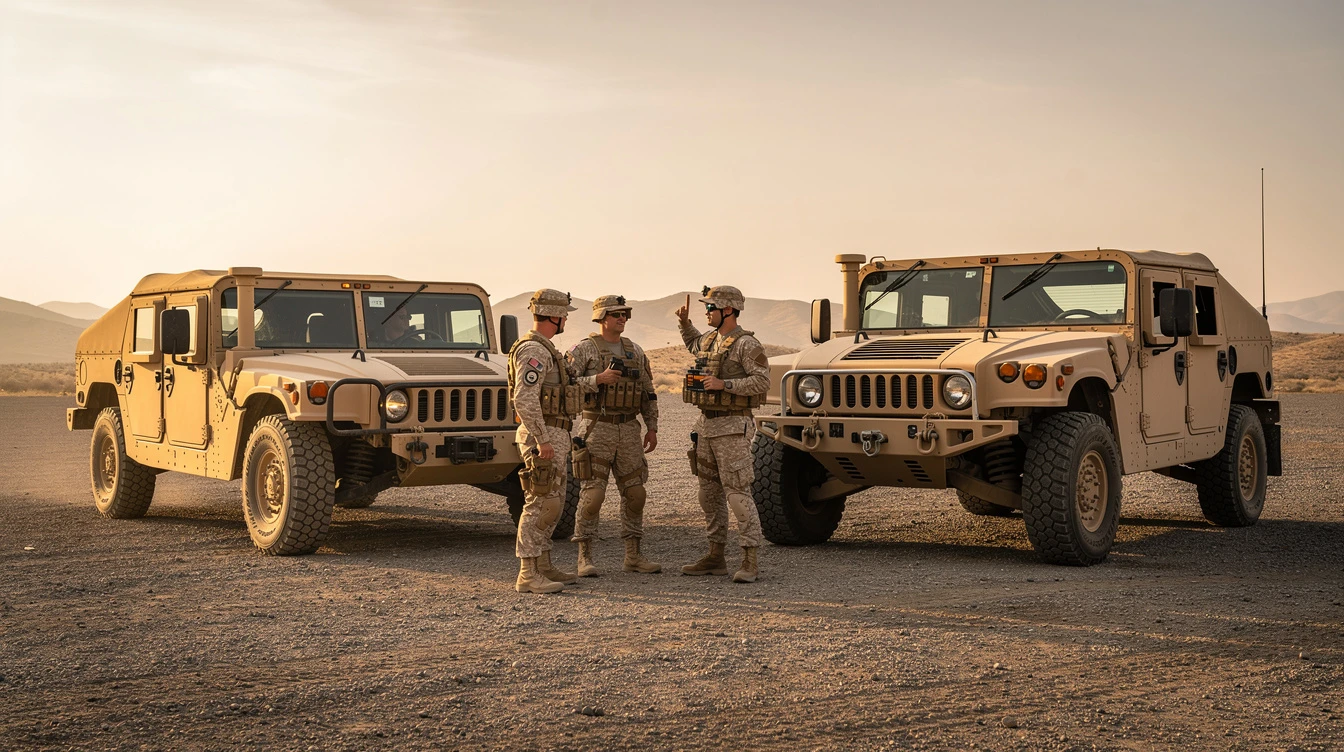
The M1165A1 HMMWV and the new Joint Light Tactical Vehicle represent two very different eras in light tactical mobility. If you're asking what separates them, the short answer is: almost everything that matters in a combat zone. Armor, power, survivability, electronic architecture, and gross vehicle weight all shifted dramatically between these two platforms.
This breakdown covers the most significant changes between the M1165A1 and the JLTV, including what those changes mean for surplus buyers and civilians who want to understand exactly what they're operating. Whether you own one, are considering buying one, or just want the technical rundown, this is the complete comparison you're looking for.
And if you already own a HMMWV and need help getting it titled and plated, we can assist with that too.
Platform Origins: Why the M1165A1 HMMWV Was Eventually Replaced
The High Mobility Multipurpose Wheeled Vehicle program dates to the early 1980s. AM General won the original contract, and for decades the HMMWV was the backbone of U.S. light tactical transport. The M1165A1 variant is a late-generation command and special purpose model, featuring the up-armored cab, expanded electronics capacity, and a 6.5L turbocharged diesel.
Honest assessment: the HMMWV was never designed to absorb IED blasts. Its flat-bottom hull and relatively low ground clearance made it vulnerable to the threat profile that emerged in Iraq and Afghanistan. By the mid-2000s, field losses were accelerating the push toward a purpose-built replacement.
What the M1165A1 Got Right
The M1165A1 variant added the Integrated Armor Package and an improved electrical system capable of supporting communications and electronic warfare loads. It retained the HMMWV's outstanding cross-country agility. The portal axle system, a major advantage over conventional truck axles, gave the HMMWV exceptional ground clearance without raising the center of gravity. That's a detail even longtime owners sometimes miss.
What the Threat Environment Exposed
Up-armor additions to the HMMWV line pushed gross vehicle weight well past the original 5,200 lb design target. That extra weight degraded the suspension, reduced fuel economy, and stressed the drivetrain. The HMMWV's basic architecture, built for speed and agility, wasn't the right starting point for a vehicle expected to survive shaped-charge attacks.
Survivability and Armor: The Biggest Structural Difference
This is where the JLTV separates itself most clearly. The Oshkosh L-ATV (Light Combat Tactical All-Terrain Vehicle), selected as the JLTV in 2015, was built around blast survivability from the ground up. The hull geometry, the seat mounting system, and the floor construction all reflect what the DoD learned the hard way from HMMWV losses.
Ready to register your vehicle?
Join thousands of vehicle owners who use HMMWV Registration to handle their registration quickly.
Get Started →Hull and Blast Protection
The JLTV uses a V-shaped hull that deflects blast energy away from the crew cabin. The M1165A1, even with its Integrated Armor Package, uses a relatively flat floor structure. That's a fundamental geometric difference, not just an armor weight difference. V-hull geometry redirects the primary blast vector, reducing transmitted shock to occupants.
JLTV ballistic protection is rated at STANAG Level 2 as a baseline, with scalable protection kits available. The M1165A1 with full armor packages reaches a comparable blast rating in some configurations, but it gets there by adding weight rather than by engineering the threat response into the structure.
Seat Suspension and Occupant Protection
The JLTV includes energy-attenuating seats as standard equipment. These seats are engineered to compress during a blast event, absorbing vertical energy before it reaches the spine. The HMMWV family did not include this feature in base configurations. Late HMMWV programs added aftermarket blast seats, but the JLTV was designed with this protection as a core requirement, not an add-on.
Powertrain and Performance: Weight vs. Power
The M1165A1 runs a GM 6.5L V8 turbocharged diesel producing around 190 hp. At its designed combat weight that was adequate. As armor additions pushed the M1165A1 past 14,000 lb, the power-to-weight ratio degraded noticeably. Operators reported sluggish acceleration, reduced off-road performance, and transmission strain under heavy load.
JLTV Powertrain Specs
The JLTV uses a 6.6L Duramax diesel producing approximately 300 hp and 700 lb-ft of torque, paired with an Allison 2500SP six-speed automatic transmission. Gross vehicle weight on the JLTV is rated at 14,000 lb in base configuration, with a higher threshold available under the protection kit configurations. Despite weighing more than a base HMMWV, the JLTV delivers meaningfully better performance under full combat load.
Payload Capacity Comparison
The M1165A1 carries approximately 2,720 lb of payload in its standard configuration. The JLTV is rated at 3,500 lb of payload. That difference compounds when you're calculating what a crew can carry in communications equipment, weapons systems, ammunition, and supplies. For support and command missions, it's a significant operational improvement.
| Specification | M1165A1 HMMWV | JLTV (L-ATV) |
|---|---|---|
| Engine | GM 6.5L V8 Turbodiesel, ~190 hp | 6.6L Duramax Diesel, ~300 hp |
| Torque | ~430 lb-ft | ~700 lb-ft |
| Payload Capacity | ~2,720 lb | ~3,500 lb |
| GVWR (combat load) | Up to ~14,050 lb (uparmored) | Up to ~14,000 lb (base) |
| Blast Protection | Flat-floor + armor package | V-hull + STANAG Level 2 baseline |
| Occupant Seats | Standard seats (blast seats added later) | Energy-attenuating seats standard |
| Transmission | 4L80-E Automatic | Allison 2500SP 6-speed |
| Ground Clearance | ~16 inches (portal axles) | ~20+ inches (adjustable suspension) |
| Independent Suspension | No (solid axles) | Yes (all four corners) |
| Civilian Surplus Availability | Yes, widely available | Not yet (still in active service) |
Suspension and Off-Road Capability
The HMMWV's portal axle design was genuinely ahead of its time. By moving the axle centerline above the wheel center, AM General gave the HMMWV a ground clearance figure that impressed operators for decades. The M1165A1 retains this system. Solid axles with portal hubs keep things mechanically simple and durable in the field.
JLTV Independent Suspension Upgrade
The JLTV uses independent suspension at all four corners, a major architectural departure from the HMMWV's solid axle setup. Independent suspension delivers better wheel articulation over broken terrain and improves on-road handling significantly. Ground clearance on the JLTV exceeds 20 inches in some configurations, aided by a suspension system that allows variable ride height adjustment.
For civilian owners, the solid-axle HMMWV is simpler to maintain. There are fewer joints, fewer failure points, and most military mechanics are trained on it. The JLTV's independent suspension is more capable on paper, but more complex to service without specialized tooling.
Highway and Road Speed
The HMMWV tops out around 70 mph in standard trim, though most operators keep it well below that. The JLTV is rated at 70 mph as well, but gets there more confidently under combat load. Road dynamics are noticeably improved thanks to the independent suspension. If you're asking whether a surplus HMMWV can be driven on the highway, the answer is yes, with the right registration and modifications. A full breakdown is available in Street Legal Humvee: What It Actually Takes to Drive One on Public Roads, which covers what you need to do before taking one on public roads.
Electronics, Networking, and Mission Systems Architecture
The M1165A1 was designed as a platform for command and special purpose missions, which meant it got more electrical capacity than baseline HMMWV variants. But the architecture is still based on mid-1990s standards. Retrofitting modern communications and networking equipment into a HMMWV is doable but often requires significant workarounds.
JLTV's ITEP-Ready Architecture
The JLTV was designed from the start to support the Army's network modernization programs. The power and data architecture supports Mounted Family of Computer Systems (MFoCS), Blue Force Tracker 2, and next-generation situational awareness tools. There are dedicated power buses, pre-routed conduit paths, and structural mounting provisions for antenna systems, all designed in rather than added on.
What This Means for Surplus Buyers
If you're buying a HMMWV at surplus auction, the M1165A1 variant often comes stripped of its communications and electronics packages before demilitarization. What you get is the platform. Getting it titled properly matters a great deal here, especially with DoD documents like the SF-97 (the DoD Certificate to Obtain Title for a Vehicle) involved in the chain of ownership. A complete walkthrough of that process is available in SF97 Title Process: How to Title Your Surplus Military Vehicle. That guide covers what the SF-97 is, how to use it, and where things typically go sideways.
Before you buy at auction, it's also smart to check for title red flags. The Military Vehicle Title Red Flags Every Buyer Needs to Know post covers the most common issues that show up in military surplus titles and how to spot them early.
What Civilian HMMWV Owners Actually Care About
The JLTV isn't on the civilian surplus market yet. Every M1165A1, M998, M1097, and other HMMWV variant that reaches the public comes through the GovPlanet surplus process, typically after being demilitarized per DoD disposal procedures. The JLTV won't reach that pipeline for years, possibly decades.
So for the owner who just picked up an M1165A1 at auction, the relevant question shifts from "how does it compare to the JLTV" to "how do I get this thing titled and street-legal." That's a different set of problems, and they're solvable. If you went through GovPlanet, there's a dedicated resource on GovPlanet Military Vehicle Registration: What to Do After You Win the Auction that walks through exactly what happens after the sale closes.
Street-Legal Requirements for HMMWV Owners
Getting a surplus HMMWV street-legal involves modifications that most states require regardless of where you title the vehicle. Headlights, turn signals, mirrors, and DOT-compliant tires are the baseline. Some states add inspections and emissions requirements on top of that. Montana vehicle registration sidesteps many of those hurdles, which is why it's a popular path for military vehicle owners.
A complete look at what's physically required is available in Humvee Street Legal Modifications: What Your HMMWV Actually Needs. For the DOT-specific compliance side, DOT Requirements for Military Vehicles: What Every HMMWV Owner Needs to Know covers federal standards and what surplus vehicles are typically expected to meet.
Titling Across All 50 States
Montana titles through an LLC structure remain one of the most widely used paths for military surplus vehicle owners nationwide. There's no sales tax, no emissions testing requirement, and the process is handled remotely. For owners who want to understand how registration works across different states, Register Military Vehicle in Any State: What Every HMMWV Owner Needs to Know breaks down the state-by-state picture. The Montana Vehicle Title and Registration page from the Montana DOJ is also worth bookmarking for fee reference.
Frequently Asked Questions
Is the JLTV a direct replacement for all HMMWV variants?
Not a one-for-one replacement across the entire fleet. The JLTV is slated to replace the light tactical roles the HMMWV filled, but the Army and Marine Corps retain large numbers of HMMWVs for non-combat support, training, and rear-echelon tasks. The JLTV program targets the highest-threat missions first. Some HMMWV variants will remain in service for years, particularly in National Guard and Reserve inventories.
Can civilians buy a JLTV as surplus?
Not currently. The JLTV is an active-duty system and hasn't entered the surplus disposal pipeline. Surplus military vehicles available to civilians today come primarily from HMMWV variants, M35 deuce-and-a-half trucks, M939 five-tons, and similar legacy platforms. The JLTV may eventually appear at GovPlanet or similar auctions, but that timeline is likely measured in decades, not years.
What does M1165A1 mean in HMMWV nomenclature?
The M1165 designates a HMMWV configured for command and special purpose missions, with expanded electrical capacity and a hardtop cab. The "A1" suffix indicates a first-generation improvement to that baseline. The A1 variant added the Integrated Armor Package provisions and updated electrical architecture. It's one of the more capable and versatile HMMWV configurations available on the surplus market.
Is a surplus HMMWV street-legal?
A surplus HMMWV is not automatically street-legal out of the auction. It typically needs DOT-compliant lighting, mirrors, turn signals, and tires at minimum. Some states add inspections or emissions testing. Titling and registration are separate from the physical modifications. Montana registration is a popular path because it doesn't require emissions testing and works for owners in any state. A full breakdown is in Street Legal Humvee: What It Actually Takes to Drive One on Public Roads.
How does the JLTV's weight compare to an up-armored HMMWV?
An up-armored M1165A1 with full armor kit can approach or exceed 14,000 lb. The JLTV in base configuration sits around 14,000 lb as well, but carries significantly more protection and payload for that weight. The key difference is that the JLTV was engineered to that weight from the start, while the HMMWV arrived there through accumulated armor additions that stressed components designed for a much lighter platform.
What is the difference between a HMMWV and a Humvee?
They're the same vehicle. HMMWV (High Mobility Multipurpose Wheeled Vehicle) is the formal military designation. Humvee is the widely recognized commercial name. AM General produced both the military HMMWV and the commercial H1 Hummer, which uses similar underpinnings but different bodywork and civilian-spec components. The H2 and H3 Hummers are GM-built civilian trucks with no direct mechanical connection to the military HMMWV platform.
Where can I find HMMWV registration help after buying at surplus auction?
Start with your paperwork. The SF-97 is the key document that transfers DoD ownership to a private buyer and establishes the chain of title. From there, the registration path depends on your state. Montana vehicle registration assistance is available for owners in all 50 states. The GovPlanet Military Vehicle Registration: What to Do After You Win the Auction post is a solid starting point. You can also reach our team directly for registration assistance tailored to your specific HMMWV variant.
What problems did the HMMWV have that the JLTV addressed?
The HMMWV's main operational weaknesses were blast vulnerability, limited payload growth margin, and increasingly strained drivetrain performance under up-armor loads. The JLTV addressed all three with a V-hull design, energy-attenuating seats, a higher-output powertrain, and independent suspension. The HMMWV also had known issues with the 6.5L diesel's reliability under sustained high-load use, particularly with the injection pump and cooling system under extreme heat conditions.
The gap between the M1165A1 HMMWV and the JLTV is real and significant, spanning blast survivability, powertrain output, suspension architecture, and electronics capacity. The HMMWV served for four decades because it was genuinely good at what it was designed to do. The JLTV replaces it because the threat environment and mission demands changed. For civilians who now own surplus HMMWVs, the platform is still capable, street-legal with the right modifications, and worth registering properly. Our team provides registration assistance for HMMWV and M-series owners across all 50 states. Reach out and we'll point you toward the right path for your specific vehicle and state.
Related Reading