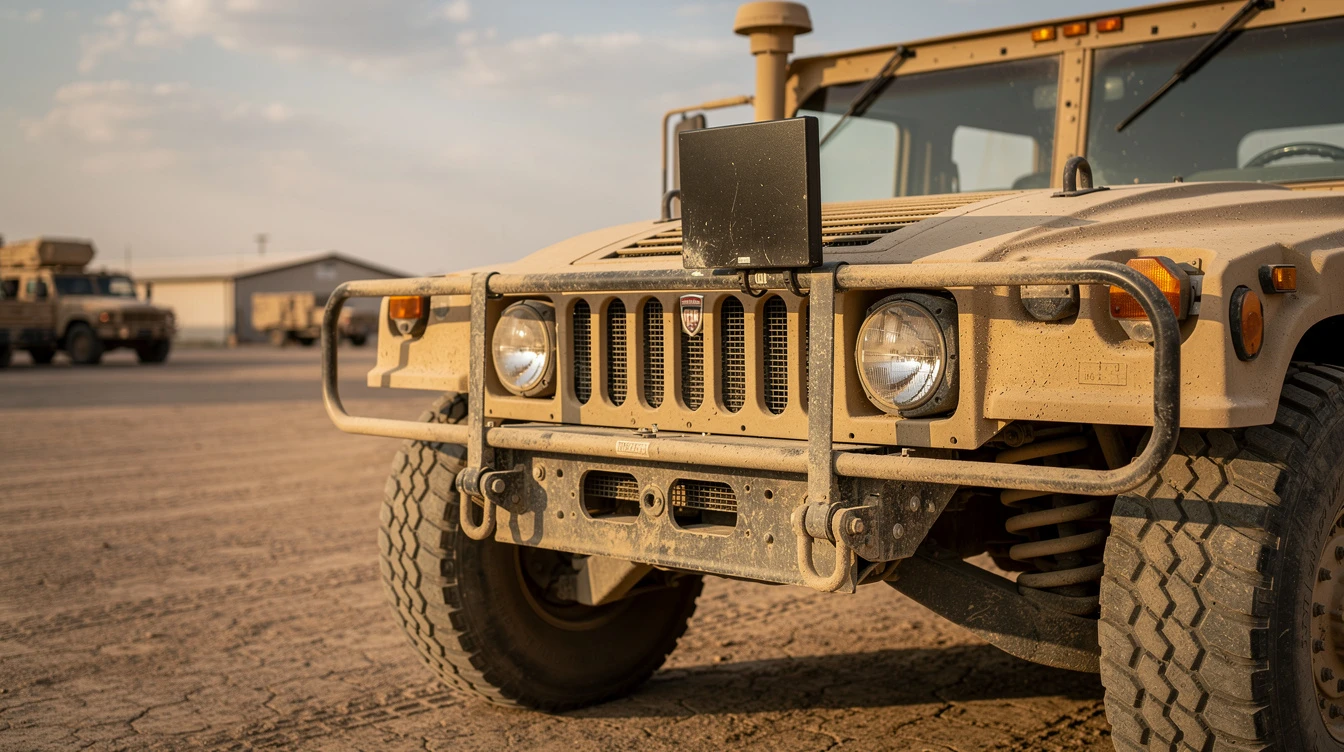
That flat, black box sticking straight up from the front bumper of a HMMWV is the convoy light housing, also called the slave receptacle box or NATO slave receptacle panel, depending on the variant. It's one of the most commonly misidentified components on a surplus Humvee, and understanding what it does matters, especially once you're getting your HMMWV street-legal and registered for public road use.
This guide breaks down exactly what that black box is, what's inside it, why it's mounted where it is, and what HMMWV owners need to know about it before modifying or registering their vehicle.
You'll also find out whether it needs to be modified, removed, or preserved to meet street-legal standards in most states.
Get Started with Your HMMWV Registration →
What the Flat Black Box on the HMMWV Front Bumper Actually Is
Updated on June 29, 2026
On most M998, M1025, M1097, and related HMMWV variants, the front bumper-mounted black box serves a dual purpose. The primary function is housing the convoy marker light, a low-profile blackout marker used during tactical convoy operations at night. The secondary, and equally important, function on many configurations is providing the NATO slave receptacle, a 24-volt jump-start connection point that lets one vehicle start another without direct battery access.
A Test
This is a test of the new blog editing and publishing feature that we are working on; please ignore. With this next update, we should be seeing the correct domain, updated with the latest version of the blog. Okay, so the issue wasn't properly resolved, but I believe it has been resolved now!
The Convoy Marker Light Function
Convoy lights allowed vehicles to follow each other in complete blackout conditions. The light emits a very dim, forward-directed glow visible only to the driver of the vehicle directly behind, not to aerial observation or enemy forces at a distance. During operations, this was critical. In a civilian context, it's basically a very dim auxiliary light with no practical street use.
The housing is deliberately flat and low-profile so it doesn't obstruct the vehicle's approach angle or interfere with the winch on variants that carry one. That's why it sticks straight up rather than mounting flush to the face of the bumper.
The NATO Slave Receptacle
On many HMMWV bumpers, the black box also contains or is mounted adjacent to a NATO 24V slave receptacle. This is a standardized connector used across military vehicles, from HMMWVs to M35 deuce-and-a-half trucks to Bradley fighting vehicles. Connect a slave cable from one vehicle to another, and you can push 24 volts to a dead battery for a field start. No jumper cables needed, no alligator clips, no hood access required.
If your HMMWV has both the convoy light and the slave receptacle in that bumper box, you've got a fully equipped tactical front end. Many demilitarized units have the housing intact, but the light or receptacle removed or disabled before surplus sale; how cool would it be to have a working NATO receptacle!
Why It's Positioned So Prominently
The vertical mounting position isn't accidental. The DoD-specified placement keeps the light visible over the hood profile of the following vehicle while preventing interference with recovery equipment. It also makes the slave receptacle accessible from a standing position without crawling under the front end, which matters in field conditions where speed and simplicity save lives.
HMMWV Front Bumper Components: What Else Is Up There
The front bumper assembly on an HMMWV is more than a steel bar. Understanding the full component set helps you know what you're looking at when you buy a surplus unit and what may need attention before road registration.
Ready to register your vehicle?
Join thousands of vehicle owners who use HMMWV Registration to handle their registration quickly.
Brush Guard and Recovery Points
Most HMMWV front bumpers include integrated brush guard rails and D-ring recovery points on either end. These are factory-spec and fully street-compliant in most states. They don't count as aftermarket modifications under typical vehicle inspection standards.
Blackout Drive Light Housing
Separate from the convoy marker, many HMMWVs also carry a blackout drive light mounted low on the passenger side of the bumper. This is a shielded headlight that directs a narrow beam downward for movement in tactical blackout conditions. Like the convoy marker, it has no practical street-legal use, but it doesn't necessarily need to be removed either, as long as your vehicle also has compliant civilian lighting installed. More detail on that topic is in Humvee Lighting Requirements for Street Legal Operation: What You Actually Need.
Tow Pintle and Trailer Connections
Many HMMWV variants also carry a front tow pintle or NATO tow hook. If your bumper has a front receiver or hook, that's for pushing disabled vehicles in a convoy, not for towing trailers from the front. Rear tow pintles handle trailer duty.
Does the Convoy Light Box Affect Street-Legal Status?
Short answer: usually not directly. The convoy light housing itself doesn't violate street-legal standards in most states, because it's typically a passive housing, not an active light that could confuse other drivers. What matters for street-legal compliance is what lights you have, not what non-functional military housings remain on the vehicle.
What States Actually Look For
When a state inspector or registration agent looks at your HMMWV's lighting setup, they're checking for:
- Functional headlights meeting minimum lumens and beam pattern requirements
- Turn signals front and rear
- Brake lights
- Taillights
- Reflectors as required
The convoy light box is not a competing or confusing light source when disabled. Most states won't flag it. That said, if the light is wired and active, you'll want to make sure it doesn't emit anything that could interfere with your civilian lighting output during a DOT-style inspection. A full breakdown of what modifications are actually required is covered in Humvee Street Legal Modifications: What Your HMMWV Actually Needs.
Montana Registration and Military Equipment
One reason many HMMWV owners choose Montana registration is that Montana has no emissions testing and no vehicle inspection requirement at the point of registration. The convoy light box, the slave receptacle, the blackout lighting, none of these create registration obstacles in Montana. You get your title and plates without a physical inspection. That's a significant advantage over registering in states that require a safety inspection before issuing plates.
Montana also charges no sales tax on vehicle registration, which matters when your HMMWV has a declared value of $15,000 or more. A full look at what Montana registration means for military vehicle owners is at Montana No Sales Tax Vehicle Registration: What Every Owner Needs to Know.
HMMWV Variant Differences: Not Every Bumper Box Is the Same
HMMWV production spans from the early 1980s through the mid-2000s, with significant changes across variants. The bumper box configuration varies by production run, mission variant, and any modifications made during military service life.
M998 and Early Variants
The original M998 cargo/troop carrier and its close variants carry the standard front bumper with the upright convoy marker housing. These are the most common surplus units on the civilian market and the configuration most people are looking at when they ask about that black box.
M1025 and Up-Armored Variants
The M1025 HMMWV armament carrier and armored variants sometimes have modified front bumpers to accommodate heavier armor packages. The convoy light box may be repositioned or integrated differently. Up-armored HMMWV variants (M1114, M1151) often have revised bumper geometry entirely.
M1097 Heavy Variant
The M1097 Heavy HMMWV has a higher GVW rating and sometimes carries additional front-mounted equipment like a deep water fording kit connection point or a front-mounted winch, which changes how the bumper box is integrated or whether it's present at all.
If you're not sure which variant you have or what documents should come with it, the Vehicle Info for Military Surplus Owners: What You Need to Register Your HMMWV page covers the key identification points and what paperwork each variant typically requires.
Getting Your HMMWV Street-Legal and Registered: What the Black Box Means for the Process
Here's the practical takeaway for HMMWV owners working through registration. The convoy light box is a non-issue for most registration paths, but the broader question of what your vehicle needs to be street-legal is worth taking seriously before you start the title and registration process.
The SF-97 and What Transfers With Your Vehicle
When a HMMWV is released from military service and sold through GovPlanet or direct surplus channels, it comes with a DoD SF-97 form (Certificate to Obtain Title to a Vehicle). That document is what converts into your civilian title. The condition of the vehicle, including the bumper box, is part of what's transferred. The SF-97 doesn't list individual components, but it does establish the vehicle's identity and demilitarization status. A full walkthrough of the SF-97 process is at SF97 Title Process: How to Title Your Surplus Military Vehicle.
What Happens After You Have the Title
Once your SF-97 converts to a state title, you're working through the same street-legal modification checklist as any other HMMWV owner. Lighting, mirrors, speedometer, and any state-specific requirements. The convoy light box typically doesn't appear anywhere on that checklist as a required modification or removal item.
For owners in states with more demanding inspection requirements, like California or Florida, the bar is higher. More on state-by-state approaches at Register Military Vehicle in Any State: What Every HMMWV Owner Needs to Know.
Ready to get your HMMWV titled and plated? Our registration specialists know military surplus paperwork inside out, from SF-97s to Montana LLC filings.
See How We Can Help With Your HMMWV Registration →
Quick Reference: HMMWV Front Bumper Box Components
| Component | Function | Street-Legal Impact | Typically Present on Surplus Units? |
|---|---|---|---|
| Convoy Marker Light Housing | Tactical blackout convoy following light | None if disabled/passive | Yes, usually housing intact |
| NATO 24V Slave Receptacle | 24V cross-vehicle jump start | None | Yes on most variants |
| Blackout Drive Light | Tactical low-beam blackout movement | None if disabled; check if active | Often present, sometimes removed |
| Brush Guard Rails | Obstacle protection | Generally compliant as-is | Yes on most |
| Front Recovery D-Rings | Recovery anchor points | None | Yes on most |
| Front Tow Pintle/Hook | Push/tow disabled vehicles | None for registration | Variant-dependent |
Frequently Asked Questions About the HMMWV Front Bumper Box
What exactly is the black box on the front bumper of a HMMWV?
It's the convoy marker light housing, and on many variants it also contains or sits adjacent to the NATO 24-volt slave receptacle. The convoy light is a tactical blackout marker used during military convoy operations to allow vehicle following in complete darkness without visible light output to aerial or ground observers at distance. The NATO slave receptacle is a standardized jump-start connector used across military vehicle fleets. Together, these are standard front bumper equipment on the M998 and most related HMMWV variants.
Does the convoy light box need to be removed to make a HMMWV street-legal?
In most cases, no. The convoy light housing is a passive component when disabled and doesn't conflict with civilian lighting standards. What matters for street-legal compliance is that your HMMWV has functioning headlights, turn signals, brake lights, and taillights that meet your state's requirements. The military bumper hardware, including the convoy light box, is generally not flagged during registration inspections. Montana registration has no vehicle inspection requirement at the point of registration, which removes this concern entirely for owners who choose that path.
Is a HMMWV street-legal on public roads?
A HMMWV can be made street-legal with the right modifications and proper registration, but it doesn't come from surplus sale ready to drive on public roads. The main requirements include compliant headlights, turn signals, mirrors, a functioning speedometer, and in many states a safety inspection. The modification list is manageable for most M998-series vehicles. A complete look at what's required is at Street Legal Humvee: What It Actually Takes to Drive One on Public Roads.
What is the NATO slave receptacle and how does it work?
The NATO slave receptacle is a standardized 24-volt electrical connector mounted on the front or rear bumper of military vehicles. It allows one vehicle to provide starting current to another through a thick-gauge slave cable without needing direct battery access. The connector is the same across NATO-standard vehicles, so an M35 deuce-and-a-half can slave a HMMWV, or vice versa. On civilian-registered HMMWVs, the receptacle is usually left in place because it adds useful field capability and doesn't create any registration or inspection issues.
What documents do I need to register a surplus HMMWV?
The primary document for most surplus HMMWVs is the SF-97 (Certificate to Obtain Title to a Vehicle), issued by the DoD at point of sale. This converts to your civilian title at the state level. You'll also typically need a bill of sale, proof of identification, and depending on your state, a vehicle inspection or weight certification. Montana registration requires no emissions test or physical inspection, which makes it a preferred route for many HMMWV owners. More on the document process at SF97 Title Process: How to Title Your Surplus Military Vehicle.
What is the difference between a HMMWV and a Humvee?
HMMWV stands for High Mobility Multipurpose Wheeled Vehicle, the official DoD designation. Humvee is the commercial name used by AM General, the manufacturer, and has become the widely recognized public name for the same vehicle. Both terms refer to the same platform. The civilian H1 HUMMER is a street-legal production version derived from the HMMWV, built to civilian standards from the factory. Military surplus HMMWVs are not the same as civilian H1s and require additional modifications and proper registration to operate on public roads.
Can you drive a HMMWV on the highway?
Yes, with proper street-legal modifications and valid registration, a HMMWV can be driven on highways in most states. The standard M998 HMMWV has a top speed of around 65-70 mph, which is adequate for highway use. The main practical considerations are fuel economy (typically 8-12 MPG on diesel variants), vehicle width (about 86 inches), and the absence of modern safety features. Width can be an issue on narrow roads or in areas with strict vehicle width regulations. Always confirm your state's specific requirements before taking a surplus HMMWV on an interstate.
What are common problems with surplus HMMWVs that buyers should know?
Common issues on surplus HMMWVs include worn or cracked soft-top and hard-top seals, degraded door seals, aged wiring harnesses especially around the convoy and blackout lighting circuits, worn brake pads and rotors from heavy use, and aging glow plugs on diesel variants. The 6.5L turbodiesel found in many mid-to-late production units has known head gasket vulnerabilities. Buyers should also check the condition of the Central Tire Inflation System (CTIS) lines and the front differential lockout actuators, as these are maintenance-intensive systems that often show deferred service on surplus units.
Your HMMWV is a serious piece of equipment. Get it properly titled, plated, and road-ready with registration assistance from specialists who know military surplus paperwork inside out.
Start Your HMMWV Registration Today
Bottom Line on That Black Box
The flat, black box sticking up from the front bumper of a HMMWV is the convoy marker light housing, often paired with a NATO slave receptacle. It's military-spec equipment built for tactical operations, not a mystery component or aftermarket add-on. For civilian owners working toward street-legal status, it's generally a non-issue for registration, but understanding what's on your vehicle is part of knowing what you've got.
Getting your HMMWV from surplus acquisition to a registered, plated, road-ready vehicle involves working through the right documentation: SF-97 to civilian title, state-specific modification requirements, and choosing a registration path that doesn't hit you with surprise fees or unnecessary inspection hurdles. Our registration specialists are ready to walk you through every step. Reach out at hmmwvregistration.com/contact or call 760-477-4191.
Related Reading
How to Avoid Vehicle Registration Delays | MRS
Vehicle registration delays cost dealers and fleet operators time and money. Learn the most common causes and what to do to keep your paperwork moving fast. 🔗DMVEz