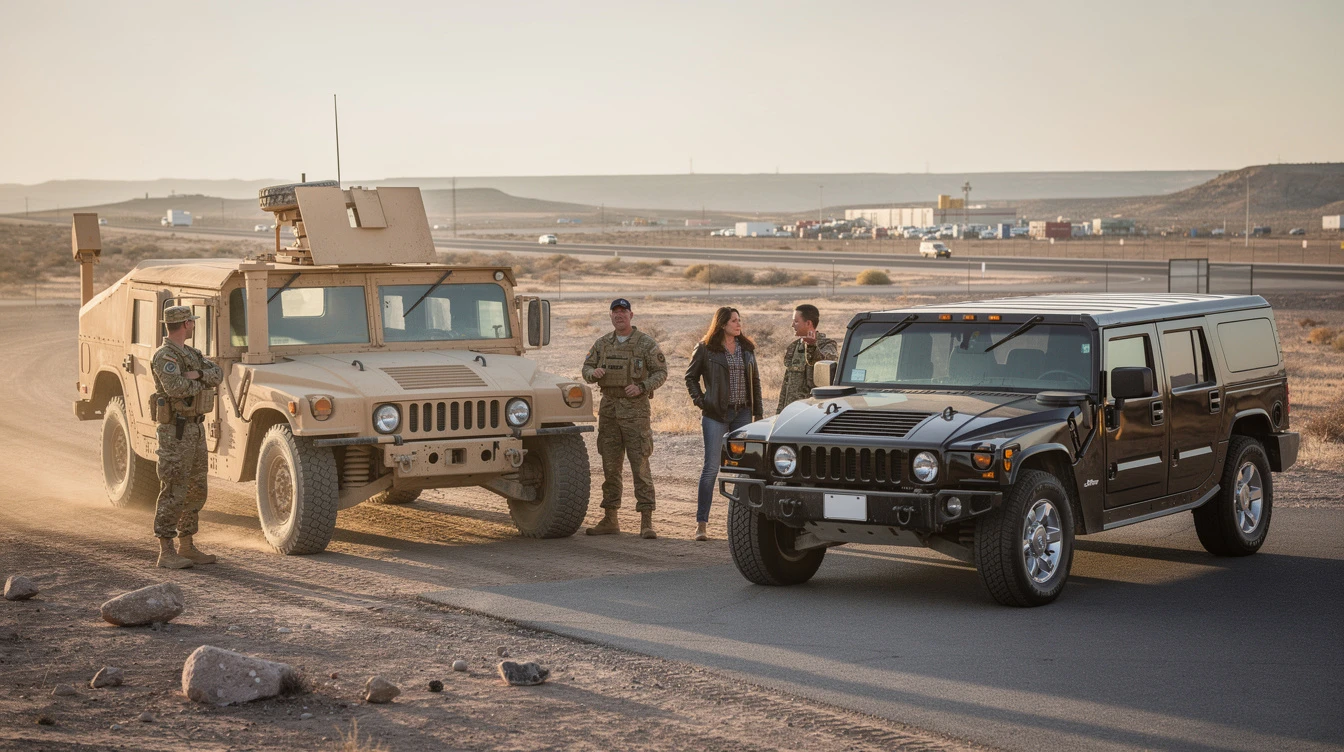
The difference between a Humvee, HMMWV, and an AM General HUMMER trips up a lot of buyers, and the confusion is understandable. Three names, one basic vehicle, but very different histories, specs, and registration paths. This guide cuts through it clearly.
You'll learn exactly where each name comes from, how the military and civilian versions differ mechanically, and what those differences mean when you're trying to get your surplus rig titled and plated. Whether you picked one up from a GovPlanet auction or inherited one from a buddy's collection, the name on your paperwork matters.
Quick note: the HMMWV is the official DoD designation. Humvee and HUMMER are both derived from it, but they don't mean the same thing. Read on.
What Does HMMWV Actually Stand For?
HMMWV is the official U.S. military designation, standing for High Mobility Multipurpose Wheeled Vehicle. The DoD adopted this platform in 1984 as a replacement for the aging M151 jeep and various other light tactical vehicles. AM General won the original production contract, and the platform has been the backbone of U.S. light tactical mobility ever since.
The military uses HMMWV in all formal documents, including the SF-97 (Certificate to Obtain Title to a Vehicle) and DD-1348 release paperwork. If you've dealt with surplus disposition forms, you've seen HMMWV printed in all caps. That's not stylistic; it's the official acronym from the program spec.
How the Nickname "Humvee" Got Established
Humvee is a phonetic compression of HMMWV. Troops in the field started using it almost immediately, and it stuck. By the time Operation Desert Storm put these vehicles on television in 1991, "Humvee" was already the name the public recognized. AM General later trademarked it, which is why you'll see "Humvee" used in both military-adjacent and commercial marketing contexts today.
For practical purposes, Humvee and HMMWV mean the same vehicle. Both are correct. This site uses them interchangeably because operators do too.
What the M998 and M1097 Designations Tell You
Within the HMMWV family, the DoD uses model codes that tell you the configuration. The M998 is the base 2-door cargo/troop carrier. The M1097 is the heavy-variant 2-door with increased payload. M1114 is the armored up-armor variant. These codes matter at the title stage, especially when your SF-97 lists a specific NSN (National Stock Number) and you need to match it to a civilian title category.
A more detailed breakdown of what to expect from the title process is available in SF97 Title Process: How to Title Your Surplus Military Vehicle. That post covers exactly how the DoD's release paperwork maps to state titling requirements.
The AM General HUMMER: A Civilian Vehicle Built on Military DNA
AM General launched the civilian HUMMER, officially badged as the H1, in 1992. Arnold Schwarzenegger is widely credited with pushing AM General to build one after seeing military HMMWVs in use during filming. That origin story is true, and it explains a lot about the H1's positioning: civilian money, military dimensions.
Ready to register your vehicle?
Join thousands of vehicle owners who use HMMWV Registration to handle their registration quickly.
Get Started →The AM General HUMMER H1 shared significant mechanical DNA with the military HMMWV. Same portal axle geometry, same wide-body stance, same 72-inch track width. But it was built from the start to meet civilian DOT and NHTSA safety standards. Different interior, different lighting setup, different emissions equipment. It wasn't a converted surplus vehicle; it was engineered as a street-legal civilian product from the ground up.
When General Motors Took the HUMMER Name
In 1999, General Motors licensed the HUMMER brand from AM General and launched the H2 in 2002, followed by the H3 in 2005. Neither the H2 nor the H3 shares meaningful mechanical lineage with the military HMMWV. The H2 was built on a GMT800 truck platform, basically a Chevy Suburban in different bodywork. The H3 was a mid-size truck derivative.
GM discontinued the HUMMER brand in 2010. AM General continued producing military HMMWVs under DoD contracts. The brands split, and today the GM-era vehicles are purely civilian trucks with no military registration considerations attached to them.
What Makes the H1 Different from a Surplus HMMWV
The most common confusion point is the H1 vs. a demilitarized HMMWV. They look similar. Both are wide, both ride high, both have portal axles. But the paperwork paths are completely different. An H1 has a standard NHTSA-compliant VIN and was sold through AM General dealerships with a certificate of origin. A surplus HMMWV comes out of the DoD disposal system with an SF-97 or a DD-1348 and no civilian VIN.
That distinction drives everything downstream: title type, registration category, and what modifications you'll need before it can run on public roads. Check the Military Vehicle Title Red Flags Every Buyer Needs to Know before you buy, especially if the seller's paperwork doesn't clearly identify which vehicle type you're getting.
Side-by-Side: HMMWV vs AM General H1 vs GM HUMMER H2
Here's where the specs actually diverge. The table below covers the key attributes that matter to owners thinking about purchase, registration, or street-legal operation.
| Feature | Military HMMWV (M998 / M1097) | AM General HUMMER H1 | GM HUMMER H2 / H3 |
|---|---|---|---|
| Manufacturer | AM General (DoD contract) | AM General (civilian) | General Motors |
| Production Years | 1984, present (ongoing contracts) | 1992, 2006 | H2: 2002, 2009 / H3: 2005, 2010 |
| Platform Origin | Purpose-built military tactical | Military-derived, DOT-certified civilian | GM truck platform (GMT800 / mid-size) |
| Track Width | ~72 inches | ~86 inches (body wider) | H2: ~74 in / H3: narrower |
| Portal Axles | Yes | Yes | No |
| Original Title Type | SF-97 / DD-1348 (military release) | Manufacturer's Certificate of Origin | Standard civilian MSO / title |
| Street-Legal from Factory | No, requires modifications | Yes | Yes |
| NHTSA-Compliant VIN | No (military serial number only) | Yes | Yes |
| Typical Surplus Source | GovPlanet, DLA, DRMO auctions | Private sale, dealers | Private sale, dealers |
| Registration Path | Specialist military vehicle process | Standard used vehicle title transfer | Standard used vehicle title transfer |
Is a Surplus HMMWV Street Legal?
A military HMMWV is not street-legal from the factory. The DoD built them to battlefield specifications, not highway safety standards. That means no DOT-approved lighting, typically no turn signals, no speedometer calibrated in mph, and no emissions equipment designed to pass civilian testing. Before a surplus HMMWV can run on public roads, you'll need to bring it into compliance.
What Modifications Are Typically Required
The modification list varies by state, but the common requirements include DOT-compliant headlights and tail lights, turn signals front and rear, brake lights, a horn, mirrors, and in many states a speedometer. Some states add seat belt requirements. Montana and South Dakota tend to have more straightforward paths for military surplus vehicles, which is why many HMMWV owners choose one of those states for registration.
The full breakdown of what your rig will likely need is covered in Humvee Street Legal Modifications: What Your HMMWV Actually Needs. That post goes deep on lighting, mirrors, and what inspectors actually look for.
For DOT-specific standards, the DOT Requirements for Military Vehicles: What Every HMMWV Owner Needs to Know post covers the federal side of the compliance picture.
Can You Drive a HMMWV on the Highway?
Yes, once it's properly registered and modified for street-legal operation. Many owners drive their HMMWVs on highways regularly. The wide track width can be a factor on narrow roads, and fuel economy is not a strength, but highway operation is entirely doable. The key is getting the title and registration right first so you're not driving unregistered.
More context on what street-legal operation actually looks like in practice is available in Street Legal Humvee: What It Actually Takes to Drive One on Public Roads.
Registration Paths: Military HMMWV vs Civilian H1
The registration path for a surplus HMMWV is genuinely different from a civilian H1 or an H2. The AM General H1 and GM H2/H3 all have standard civilian titles. You buy one, get the title signed over, and register it like any used vehicle. Straightforward.
A surplus military HMMWV doesn't have a civilian title at all. It has military release paperwork, usually an SF-97 (the DoD's equivalent of a certificate of origin for surplus vehicles), sometimes accompanied by a DD-1348. You have to convert that into a state-issued title before you can register the vehicle. That process involves establishing the vehicle's identity through the military serial number, submitting the SF-97 to the state, and in some cases applying for a bonded title if documentation is incomplete.
Why Montana and South Dakota Work Well for HMMWV Owners
Montana has no sales tax on vehicle purchases and no emissions testing. South Dakota has low fees and a simplified title process. Both states have handled military surplus vehicle registrations consistently, and both have clear frameworks for working through SF-97 documentation. For owners in states with stricter requirements or high tax exposure, registering through one of these states can make a significant difference.
The full state-by-state picture is in Register Military Vehicle in Any State: What Every HMMWV Owner Needs to Know. That resource covers what each state requires and where the friction points are.
Montana's registration fee structure is publicly documented on the Montana Vehicle Title and Registration page, which outlines the costs involved and what you'll need to submit.
What Happens After a GovPlanet Auction
A lot of HMMWV owners come into their vehicle through GovPlanet, the Defense Logistics Agency's primary surplus auction platform. GovPlanet provides the SF-97, which is your starting point for the civilian title process. The timeline from auction win to plates in hand depends on which state you're registering in and how clean your paperwork is.
The post-auction process is covered in detail in GovPlanet Military Vehicle Registration: What to Do After You Win the Auction. Read that before you pick up the vehicle.
Frequently Asked Questions
Is "Humvee" the same as "HMMWV"?
Yes. Humvee is a phonetic nickname derived from the HMMWV acronym (High Mobility Multipurpose Wheeled Vehicle). Both names describe the same military tactical vehicle manufactured by AM General under DoD contracts. AM General holds the trademark on "Humvee," but the term is widely used informally to describe any HMMWV-platform vehicle. On this site, both names are used interchangeably because that's how operators actually speak.
What is the difference between an AM General HUMMER and a GM HUMMER?
The AM General HUMMER H1 (1992-2006) was a civilian adaptation of the military HMMWV, built by the original military contractor with portal axles and military-derived engineering. The GM HUMMER H2 and H3 were licensed by General Motors starting in 2002, built on standard GM truck platforms with no military mechanical lineage. The H2 is essentially a modified GMT800 truck. The H3 was based on a mid-size platform. Both GM models are straightforward used vehicles; the H1 is a different animal entirely.
Can you register a demilitarized HMMWV the same way as a civilian Humvee?
No. A demilitarized HMMWV from surplus disposition comes with military release paperwork (SF-97 or DD-1348), not a civilian title. You have to convert that paperwork into a state-issued title before you can register it. A civilian AM General H1 already has a standard certificate of origin or existing state title, so it follows the same process as any other used vehicle. The military surplus path requires specialist handling and typically takes longer.
What does "demilitarized" mean for an HMMWV?
Demilitarization (DEMIL) is the process by which the DoD removes military utility from surplus equipment before releasing it to the public. For HMMWVs, DEMIL typically means the vehicle has been cleared for civilian ownership without classified or controlled components. DEMIL codes on the release paperwork tell you the level of demilitarization applied. Some DEMIL levels allow full civilian use; others have restrictions. Your SF-97 should reflect DEMIL status, and that status affects what a state will accept for titling purposes.
How does a Humvee compare to a Jeep?
The Humvee replaced the M151 military jeep in U.S. service starting in 1984. Jeeps (civilian CJ and later Wrangler models) are far lighter, narrower, and more nimble in tight terrain. HMMWVs are wider by design, optimized for high payload and stability over rough ground rather than tight maneuvering. Registration-wise, civilian Jeeps are standard vehicles. Military jeep variants (M151, M38) follow the same surplus paperwork path as HMMWVs. The mechanical comparison between the two platforms is similar in spirit but very different in scale.
Where can I find a Humvee for sale with clean paperwork?
GovPlanet is the primary source for surplus military HMMWVs with documented SF-97 paperwork. Private sellers also list them, but paperwork quality varies. Always verify that the SF-97 is present and that the vehicle's serial number matches what's on the form. Missing or mismatched paperwork can result in a bonded title requirement, which adds time and cost to the registration process. The Military Vehicle Title Red Flags Every Buyer Needs to Know post lists the warning signs to look for before you commit to a purchase.
Do HMMWVs have safety issues owners should know about?
Military HMMWVs were built for tactical use, not occupant safety in the civilian sense. Common issues include the absence of airbags, minimal crumple zones, and original equipment not meeting DOT lighting standards. Older platforms may also have deferred maintenance from military use. Before purchasing, a pre-buy inspection by someone familiar with M-series vehicles is worth the time. Check out Military Vehicle Safety Requirements: What Every Surplus Owner Must Know for a full rundown of what civilian operation requires.
Ready to Get Your HMMWV Titled and Plated?
Whether you're holding SF-97 paperwork on a fresh GovPlanet win or sorting out a title on a HMMWV you've owned for years, the registration path for a surplus military vehicle is not the same as a standard used car. The names, Humvee, HMMWV, AM General HUMMER, all describe related but legally distinct vehicles. Getting clear on which one you have, and what paperwork you're starting with, is the first step toward getting it registered and on the road.
HMMWV Registration specializes in exactly this. We provide registration assistance for military surplus vehicles in all 50 states, with Montana and South Dakota registration paths available for owners who want to skip sales tax and emissions testing. Tell us what you've got and we'll map the right path forward.
More resources for HMMWV owners: Vehicle Info for Military Surplus Owners: What You Need to Register Your HMMWV covers what to gather before you start. For insurance considerations, Military Vehicle Insurance Requirements: What Every HMMWV Owner Must Know has what you need to know before the plates go on.
Related Reading