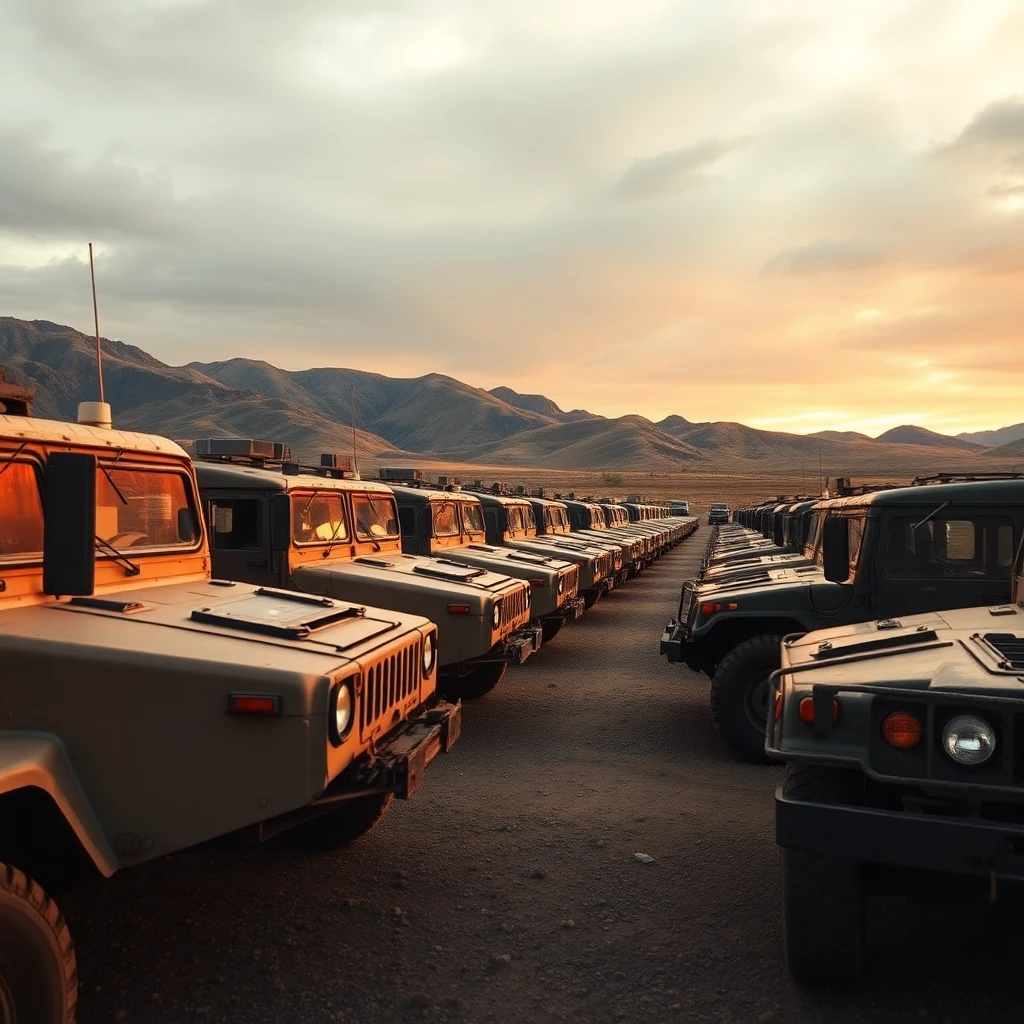
The HMMWV, or High Mobility Multipurpose Wheeled Vehicle, is the backbone of U.S. military ground mobility, and it's been that way since the early 1980s. If you've ever seen a Humvee rolling through desert terrain on the news, that's what we're talking about. This guide covers what the HMMWV military vehicle actually is, how it differs from civilian versions, what the known problems are, and, critically, what you need to do once you've acquired one as surplus.
You'll also find a breakdown of variants, a comparison table, answers to the most common questions buyers ask, and direct paths to getting your HMMWV plated and street-legal. Whether you just won one at auction or you're still researching before buying, this is the operational guide you need.
Read straight through or jump to the section that matters most to you right now.
What the HMMWV Military Vehicle Actually Is
HMMWV stands for High Mobility Multipurpose Wheeled Vehicle. The U.S. military adopted it in 1984 as a replacement for the aging Jeep M151 and other light utility vehicles that had served since Vietnam. AM General won the production contract, and the first units rolled into service the same year.
The platform was purpose-built for one mission: get personnel and equipment across any terrain, in any conditions, fast. It runs on a 6.2L or 6.5L diesel engine (depending on the variant and production year), features a centrally mounted engine and transmission tunnel, and sits on portal axles that give it exceptional ground clearance, typically 16 inches. That chassis geometry is a big part of why it handles soft ground, steep grades, and debris-strewn roads better than anything in its class.
HMMWV vs. Humvee vs. AM General HUMMER: What's the Difference?
These three names cause constant confusion. Here's the short version:
- HMMWV: The official military designation. Used in all DoD documentation, maintenance manuals, and procurement records.
- Humvee: The widely recognized commercial name AM General uses for the military vehicle itself. HMMWV and Humvee mean the same thing, different label.
- AM General HUMMER (H1): The civilian version, sold commercially starting in 1992. It shares DNA with the HMMWV but was built to different spec, with creature comforts and street-legal equipment from the factory.
- H2 and H3: General Motors consumer trucks wearing Hummer branding. They share almost nothing mechanical with the original HMMWV platform. Different vehicle, different company, different mission.
When we talk about surplus military vehicles, we mean the HMMWV, not the H2 or H3.
How the HMMWV Compares to a Jeep
The HMMWV replaced the Jeep in U.S. military service, but the two vehicles are genuinely different machines. The Jeep M151 was light, narrow, and relatively easy to flip. The HMMWV is wide, low-slung, and planted, with a 72-inch track width that makes rollovers far less likely on normal terrain. It's also significantly heavier, at 5,200 lbs for a base M998 without add-on armor. The Jeep was designed for a different era of warfare. The HMMWV was designed to survive a different kind of threat environment, and that shows in the design from the ground up.
HMMWV Variants: M998 to M1114 and Beyond
There isn't one HMMWV. There are more than a dozen primary variants, plus dozens of sub-configurations based on mission requirements. Most surplus buyers encounter a handful of the most common ones. Knowing which variant you have matters for parts sourcing, registration weight class, and modifications needed to make it street-legal.
Ready to register your vehicle?
Join thousands of vehicle owners who use HMMWV Registration to handle their registration quickly.
Get Started →Most Common Surplus HMMWV Variants
| Designation | Body Type | Primary Use | Curb Weight (approx.) |
|---|---|---|---|
| M998 | 2-door cargo/troop carrier | General utility, troop transport | 5,200 lbs |
| M1025 / M1026 | Armament carrier | Weapons platform, armed patrol | 5,900 lbs |
| M1035 | Soft-top ambulance | Medical support | 5,600 lbs |
| M1045 / M1046 | Armament carrier, improved suspension | Heavy weapons support | 6,100 lbs |
| M1097 | Heavy Variant (HVHMMWV) | Higher payload, shelter carrier | 6,500 lbs |
| M1114 | Up-Armored HMMWV (UAH) | High-threat patrol, IED environments | 12,100 lbs |
| M1151 / M1152 | Expanded Capacity Vehicle (ECV) | Updated general utility | 7,700 lbs |
The M1114 and other up-armored variants present specific challenges for civilian registration due to their weight class. The lighter M998 and M1097 are the most common surplus buys and the most straightforward to plate. Check your vehicle's data plate and compare it against your state's weight class thresholds before you start the title process.
What Is That Black Box on the Front Bumper?
A common question from new owners: what is the flat, black box sticking straight up from the front bumper of some HMMWVs? In most cases, that's a slave receptacle cover or a front tow pintle guard. On some configurations it can be a brush guard mounting bracket, an antenna base, or a blackout driving light housing. If yours has electrical connectors behind it, it's almost certainly the slave start receptacle, used for jump-starting the vehicle from another military asset using a NATO slave cable rather than jumper cables.
Known Problems With the HMMWV
The HMMWV is a capable platform, but surplus buyers should know its weaknesses before they sign anything. Most of these problems are manageable, but they affect maintenance costs and registration viability.
Common Mechanical Issues
- Cooling system failures: The 6.5L diesel is prone to overheating if the cooling system isn't maintained. Head gaskets go. Budget for a cooling system inspection before first use.
- Central tire inflation system (CTIS) leaks: The CTIS lets you adjust tire pressure on the move, but the rotary unions that connect the system to each wheel hub are notorious for slow leaks. Not dangerous, but annoying and expensive to rebuild.
- Electrical gremlins: Military wiring harnesses take abuse. Corrosion, spliced repairs, and non-standard modifications show up in almost every surplus vehicle. Expect to do a wiring audit.
- Portal axle hub leaks: The axle housings use a lot of seals. Aged seals leak gear oil. Inspect all four corners before any long drive.
- Body panel rot: Aluminum body panels resist rust, but dissimilar metal corrosion where aluminum meets steel fasteners is common, especially on vehicles that spent time in humid or coastal environments.
Street-Legal Gaps That Need Addressing
The HMMWV wasn't designed to meet FMVSS (Federal Motor Vehicle Safety Standards). That matters when you try to plate it. Most surplus HMMWVs are missing turn signals, brake lights compliant with civilian spec, a speedometer, mirrors, and sometimes a horn. These aren't dealbreakers. They're a checklist. A more complete breakdown of what modifications are required is in Humvee Street Legal Modifications: What Your HMMWV Actually Needs, which covers the full modification list by system.
For DOT-specific requirements by category, the DOT Requirements for Military Vehicles: What Every HMMWV Owner Needs to Know post covers lighting, braking, and structural standards in detail.
Is a HMMWV Street-Legal? Can You Drive One on the Highway?
Yes, with the right modifications and registration. The HMMWV is not street-legal as-delivered from surplus. It lacks civilian-required safety equipment and has no title in the traditional sense when it leaves DoD inventory. Both of those issues are solvable.
What You Need to Drive a HMMWV on Public Roads
- A valid title (from the SF-97 issued at point of transfer, or a bonded title in some states)
- Current registration and plates
- Functioning turn signals, brake lights, headlights, taillights, and reverse lights
- Mirrors (driver and passenger side)
- A working speedometer
- A horn
- Windshield wipers on vehicles with a windshield
The SF-97, or "Certificate to Obtain Title to a Vehicle," is the DoD form issued when a military vehicle is transferred to civilian ownership. That document is what you use to obtain a state title. Without it, you're working with a bonded title process, which is more involved but still achievable. The SF97 Title Process: How to Title Your Surplus Military Vehicle post walks through both paths.
Driving a HMMWV on the Highway: What to Know
Most HMMWVs are electronically governed to around 55-65 mph. On a highway with a 70 mph limit, that's a real-world constraint. The vehicle is also wide, at 85 inches, which can be tight in lanes designed for standard passenger cars. That said, thousands of owners drive them on highways daily without issue. You'll want to confirm your state's rules on oversized vehicle operation for anything wider than 96 inches, but the standard M998-series falls just under that threshold.
For a full breakdown of what street-legal operation involves, read Street Legal Humvee: What It Actually Takes to Drive One on Public Roads.
How Surplus HMMWVs Enter Civilian Hands
The DoD disposes of surplus military vehicles through several channels. GovPlanet is the most common online auction platform for HMMWV sales, operated through Ritchie Bros. GSA Auctions also lists military surplus. Some vehicles move through state and local government surplus programs, and others go through DRMO (Defense Reutilization and Marketing Office) sales.
What Documentation Comes With a Surplus HMMWV
What you receive at transfer matters a lot for the title process. In the best case, you get an SF-97 directly from the issuing office. In many GovPlanet sales, the SF-97 arrives from the auction house after the transaction closes. Some older transfers or non-standard sales produce a DD-1348 (the document used for DoD property transfers) instead, which requires additional steps to convert into a state title.
A detailed look at what to do after you win at auction is in GovPlanet Military Vehicle Registration: What to Do After You Win the Auction.
Army Surplus Military Vehicles Beyond the HMMWV
The HMMWV gets most of the attention, but DoD surplus sales also include M35 deuce-and-a-half trucks, M939 5-ton trucks, LMTVs, FMTVs, MRAPs, and occasionally older M151 Jeeps. Each platform has different title documentation, weight class considerations, and modification requirements. If you're working with an M35 specifically, the M35 Deuce and a Half Registration: What You Need to Know post covers that platform in detail. For MRAPs and other heavy platforms, see the LSSV LMTV MRAP Military Vehicle Registration Guide: What Every Owner Needs to Know.
Registering Your HMMWV: Montana, South Dakota, and Your Options
Once you have your SF-97 or title documentation in hand, you need to register the vehicle. This is where many owners get stuck. Standard state DMV processes often aren't built for military surplus vehicles, which have no MSO (Manufacturer's Statement of Origin) and no standard VIN format in the civilian sense. Montana and South Dakota are the two most operator-friendly states for military vehicle registration.
Why Montana Works for HMMWV Registration
Montana has no sales tax, no emissions testing, and no safety inspection requirement for vehicle registration. For a surplus HMMWV that may need modifications to meet street-legal standards, that last point is significant. You're not being tested against FMVSS before you get plates. Montana also has specific provisions for military surplus vehicles that make the title and registration path more direct than most states. Per the Montana Vehicle Title and Registration fee schedule, registration costs are predictable and reasonable for this class of vehicle.
An overview of how registration works across all 50 states is available in Register Military Vehicle in Any State: What Every HMMWV Owner Needs to Know.
The Title Transfer Process for HMMWV Owners
Title transfer for a surplus HMMWV is the step that trips up most owners. The SF-97 is not a title. It's a certificate that authorizes you to obtain a title. You take that document, plus proof of identity and any applicable fees, to a county treasurer (in Montana) or motor vehicle office to convert it into a state title. If your vehicle came without an SF-97, you may be looking at a bonded title process.
The full cost and timeline breakdown is in HMMWV Title Transfer: What You Need, What It Costs, and How to Get It Done. Read that before you start the paperwork.
Frequently Asked Questions About the HMMWV
What does HMMWV stand for?
HMMWV stands for High Mobility Multipurpose Wheeled Vehicle. The U.S. military adopted the designation in 1984 when AM General's design won the contract to replace the M151 Jeep series. The informal name "Humvee" comes from the pronunciation of the HMMWV acronym and is used interchangeably in both military and civilian contexts. The civilian commercial version, sold starting in 1992, was branded the AM General HUMMER H1.
What is the difference between a Humvee and a civilian Hummer?
The Humvee (HMMWV) is a purpose-built military vehicle made by AM General. The civilian HUMMER H1, also made by AM General, is a street-legal variant with added comfort features. The H2 and H3 were General Motors consumer trucks with Hummer branding but no mechanical relationship to the original platform. When people talk about surplus military vehicles, they mean the HMMWV, not the H2 or H3.
Can you buy a surplus HMMWV?
Yes. The DoD regularly releases surplus HMMWVs through GovPlanet, GSA Auctions, and DRMO sales. Prices vary significantly by variant, condition, and included documentation. Most surplus units sell without street-legal equipment. You'll receive either an SF-97 or a DD-1348 as your transfer document, which you then use to obtain a state title. Budget for modifications in addition to the purchase price.
Is a HMMWV street-legal from the factory?
No. Military HMMWVs are not built to FMVSS standards and do not come equipped with all civilian-required safety equipment. Most surplus units are missing compliant turn signals, mirrors, speedometers, and lighting. These can be added, and many owners complete the modifications themselves. The specific list of what's required depends on your state's registration rules. Montana's no-inspection policy makes it one of the more accessible states for this process.
What engine does the HMMWV use?
Most HMMWVs run a 6.2L or 6.5L GM diesel V8. The 6.2L was standard in early production units. The 6.5L (turbocharged in many applications) became the standard in later variants. Both are indirect-injection diesels known for durability. Common failure points include the injection pump on the 6.5T and cooling system components on both. The engine is mounted centrally in the vehicle, giving the HMMWV its distinctive flat-front profile.
What is the HMMWV equivalent in other militaries?
Several militaries operate HMMWV-equivalent light utility vehicles. The Indian Army uses the Tata LPTA 715 and the Mahindra MRAP-series for comparable roles, though neither matches the HMMWV's specific portal axle design. The British military used the Land Rover Wolf and now fields the Foxhound. Russia used the UAZ-469 and now operates the Tigr. Australia fields the G-Wagon. Each represents a similar operational concept, high mobility light utility, adapted to national procurement and terrain requirements.
How do I check the title status of a surplus HMMWV before buying?
Military vehicles don't always appear in standard VIN databases because their identification numbers don't follow civilian VIN formats. Before purchasing, ask the seller for the SF-97 or proof of the title documentation path. Confirm the BUMPER NUMBER matches the vehicle you're inspecting. Watch for red flags like missing documentation, altered ID plates, or a seller who can't explain the transfer chain. The Military Vehicle Title Red Flags Every Buyer Needs to Know post covers the warning signs in detail.
What safety equipment does a HMMWV need to be street-legal?
At minimum: working headlights, taillights, brake lights, turn signals, a horn, mirrors (driver and passenger side), a speedometer, and windshield wipers if the vehicle has a windshield. Some states add requirements for seat belts, reflectors, and specific lighting standards. Montana and South Dakota are among the most accessible states for military vehicle registration. The full safety checklist is covered in Military Vehicle Safety Requirements: What Every Surplus Owner Must Know.
Montana's no-sales-tax, no-emissions policy also affects total cost of ownership. The Montana No Sales Tax Vehicle Registration: What Every Owner Needs to Know post explains how that works and what it saves you at registration time.
Ready to Get Your HMMWV Plated?
The HMMWV is one of the most capable and recognizable military vehicles ever built. Getting one titled, registered, and street-legal is a solvable problem, and you don't have to work through it alone. Our team specializes in military surplus vehicle registration, from SF-97 processing to Montana title and plate issuance. We manage the out-of-state paperwork with our paperwork support, so you're not figuring out county treasurer protocols from scratch.
Tell us what you have. We'll give you a clear path forward.
Related Reading