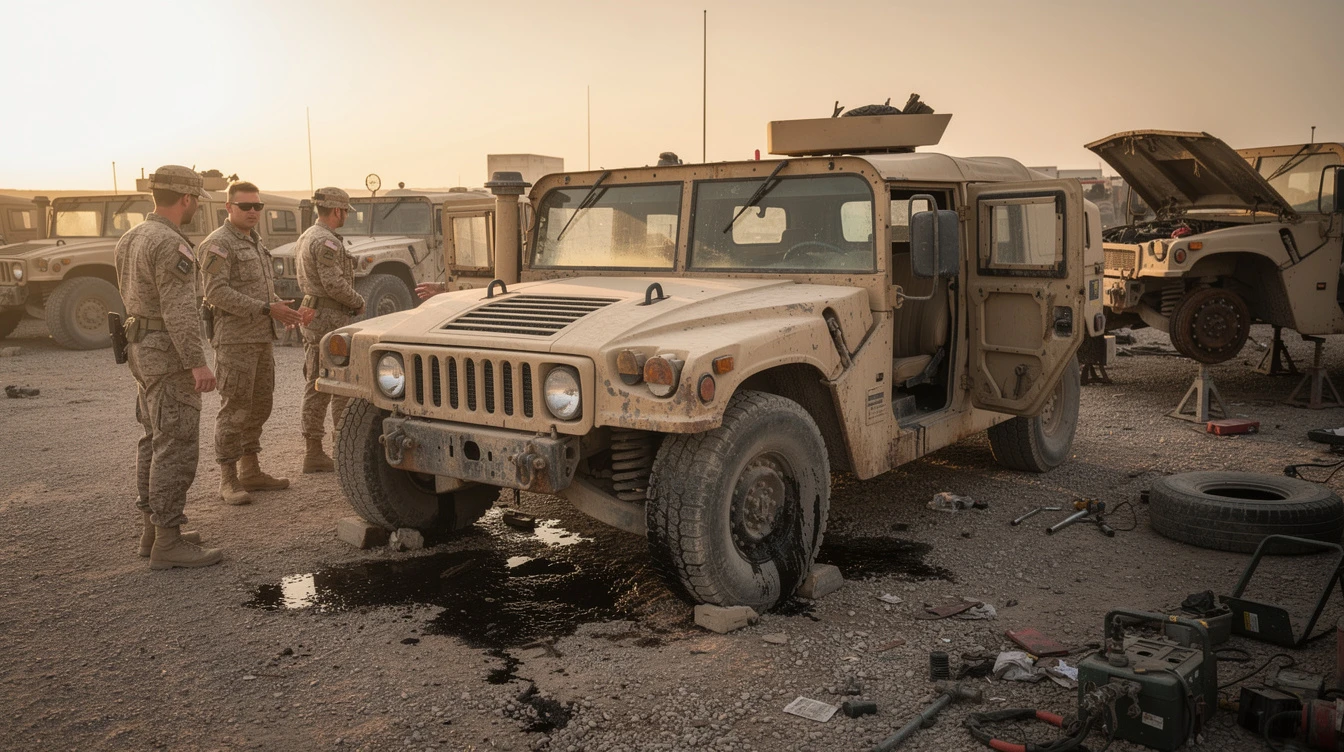
The HMMWV military Hummer is one of the most capable army surplus military vehicles ever built. But owning one on the civilian side means inheriting a platform that was designed for combat logistics, not commuting. The problems owners run into aren't random. They're predictable, well-documented, and manageable, if you know what to expect before you buy.
This guide covers the most common mechanical, electrical, and ownership issues with the Humvee, including what breaks, what costs the most to fix, and what gets in the way of getting one street-legal and registered. Whether you picked yours up at a GovPlanet auction or through a private transfer, read this before you put miles on it.
Honestly, most of these issues have known fixes. The HMMWV was built to be field-maintained by soldiers with basic tools, so parts availability is strong and the tech manuals are thorough. You just need the right information going in.
The Most Common Mechanical Problems With the HMMWV
The M998 and related variants use a 6.2L or 6.5L diesel engine from GM. These engines were not performance-oriented, they were built for reliability in extreme conditions. But they come with real weaknesses, and most surplus HMMWVs have high hours on them by the time they reach civilian hands.
Cooling System Failures Are the Number One Issue
The 6.2L runs hot. The cooling system on early HMMWVs was undersized for the engine's output, especially under load. Cracked heads, warped gaskets, and blown radiators are common on vehicles that weren't properly maintained during service. When you buy a surplus HMMWV, assume the cooling system needs a full inspection. Replacement parts are available, but the labor can be significant given the tight engine bay.
Glow Plug and Starting Problems in Cold Weather
The 6.2L has no fuel injection system in the modern sense. It relies on glow plugs to pre-heat the combustion chamber for cold starts. Those plugs fail. A HMMWV that starts fine in summer may refuse to turn over at 20 degrees. Replacing glow plugs on the 6.2L requires removing the intake manifold, which is a multi-hour job. The 6.5L improved on this somewhat, but the issue persists on older units.
Transfer Case and CTIS Leaks
The Central Tire Inflation System (CTIS) is one of the most impressive features on the HMMWV, and one of the most common failure points. It runs pneumatic lines throughout the drivetrain to allow on-the-fly tire pressure adjustment. Those lines crack, fittings fail, and hub seals leak. A HMMWV with a non-functional CTIS isn't undriveable, but it's missing a core capability. Rebuilding it correctly takes patience and correct parts sourcing. Transfer case oil leaks are also routine on high-mileage units.
Electrical System Problems That Catch Owners Off Guard
Military vehicles are wired for military use. That sounds obvious, but the implications run deep. The HMMWV's electrical system was designed for battlefield reliability, not civilian convenience, and it shows in everything from the lighting setup to the battery arrangement.
Ready to register your vehicle?
Join thousands of vehicle owners who use HMMWV Registration to handle their registration quickly.
Get Started →Dual Battery System Complexity
Most HMMWVs run dual 12V batteries wired in parallel. The batteries are positioned in the engine bay under the hood, and they're exposed to significant heat. Battery degradation is fast in this environment. Owners often find that one battery is pulling down the other, causing intermittent starting issues that are difficult to diagnose without testing both batteries individually. Worth replacing both at once when one fails.
Lighting That Doesn't Meet Civilian Standards
This is where the street-legal gap becomes real. Military Humvees don't come with DOT-compliant lighting from the factory. They were built for blackout operations and combat use, not highway driving. The headlights, taillights, turn signals, and brake lights on a surplus HMMWV typically need to be replaced or added before the vehicle meets civilian road requirements. This is a known modification every civilian owner has to address.
For a full breakdown of what modifications are required, see Humvee Street Legal Modifications: What Your HMMWV Actually Needs. That guide covers each required system in detail, from lighting to mirrors to speedometers.
Corrosion in Wiring Harnesses
Surplus HMMWVs have been in the field. Desert heat, jungle humidity, salt water crossings. The wiring harnesses absorb all of it. Corroded connectors cause ghost electrical issues that are difficult to trace. A HMMWV with a history of overseas deployment is at higher risk. Inspect the use carefully before purchase, and budget for repairs if you see green-tinged connectors or brittle insulation.
Ownership and Registration Problems Specific to the Humvee
Beyond the mechanical side, the HMMWV creates a specific set of ownership challenges that civilian vehicles don't. Most of these come from the vehicle's military origin, its documentation chain, and the gap between DoD disposal processes and state registration requirements.
The SF-97 and Title Chain Issues
When the military disposes of a HMMWV through Defense Logistics Agency (DLA) channels, the vehicle comes with an SF-97, which is the federal document used in place of a traditional Manufacturer's Certificate of Origin. Getting a clean civilian title from an SF-97 is possible, but it requires knowing the correct process for your state. Many first-time buyers are surprised when the state doesn't recognize the SF-97 directly and asks for additional documentation.
If your paperwork has gaps, the SF97 Title Process: How to Title Your Surplus Military Vehicle guide walks through the full process from the federal disposal document to a clean civilian title.
Also watch for red flags in the title chain before buying. Military Vehicle Title Red Flags Every Buyer Needs to Know covers the most common documentation problems that surface during title transfers on surplus units.
Is the HMMWV Street-Legal? Not Without Work.
The short answer: a stock surplus HMMWV is not street-legal in most states without modifications. The vehicle lacks DOT-compliant lighting, mirrors, a speedometer, and sometimes braking standards required by civilian road law. This surprises buyers who assume a military vehicle would automatically meet civilian standards. It doesn't, and that gap needs to be addressed before you can drive on public roads.
The full picture is covered in Street Legal Humvee: What It Actually Takes to Drive One on Public Roads. That article covers what modifications are typically required by state and what the registration path looks like after those modifications are made.
Can You Drive a HMMWV on the Highway?
This comes up constantly. Technically, a properly modified and registered HMMWV can drive on most U.S. highways. The vehicle's top speed of around 65, 70 mph is within highway minimums in most states, but barely. The real limitations are fuel economy (expect 10, 12 MPG on the 6.2L), tire wear at highway speed, and the fact that some states have width or height restrictions that may affect certain variants. A HMMWV on a public highway is a different experience from field driving. Plan your routes accordingly.
| Problem Area | Typical Symptom | Owner Action | Severity |
|---|---|---|---|
| Cooling System | Overheating, cracked heads | Full inspection at purchase, flush and replace | High |
| Glow Plugs | Hard cold starts | Replace glow plugs, check controller | Medium |
| CTIS Leaks | Tire pressure loss, air leaks | Inspect hubs and lines, rebuild or delete | Medium |
| Dual Battery System | Intermittent starting | Test and replace both batteries together | Low-Medium |
| Lighting Compliance | Non-DOT lights from factory | Install DOT-compliant lighting kit | High (for street use) |
| Wiring use Corrosion | Electrical gremlins | Inspect connectors, replace corroded sections | Medium-High |
| SF-97 Title Issues | State won't accept military title | Work with a military vehicle title specialist | High (for registration) |
| Transfer Case Leaks | Oil loss, drivetrain noise | Reseal or replace transfer case | Medium |
Long-Term Ownership Costs and What to Budget
The HMMWV has a reputation for being cheap to buy and expensive to own. That reputation is partially earned. Parts are generally available through military surplus suppliers, and the TM (Technical Manual) system means repair information is thorough and often free. But labor rates on specialty military vehicles are high, and some repairs require specialized knowledge.
Parts Availability Is a Genuine Advantage
Unlike many surplus military vehicles, the HMMWV was produced in huge numbers. AM General built over 280,000 units for the U.S. military alone. That production volume means parts are widely available. Everything from engine components to body panels to CTIS parts can be sourced through military surplus vendors, eBay, and specialized dealers. This is a real advantage over rarer platforms.
Insurance and Registration Add Up
Insuring a HMMWV as a street-legal civilian vehicle requires finding a carrier that understands military surplus vehicles. Many standard auto insurers won't write a policy for an M998. Specialty carriers exist, and rates vary based on use. Add in annual registration fees and any state-specific compliance costs, and the ongoing ownership expense is real.
For insurance specifics, Military Vehicle Insurance Requirements: What Every HMMWV Owner Must Know covers what carriers look for and how to get properly covered.
Montana Registration as a Cost-Reduction Strategy
Montana has no sales tax on vehicles, no emissions testing, and no annual safety inspections required at the state level. For high-value surplus military vehicles, that sales tax gap alone can represent thousands of dollars in savings. Many HMMWV owners across all 50 states use Montana registration to reduce their cost of ownership at the title and registration stage.
The full picture on fees and requirements is on the Montana Vehicle Title & Registration Fees page from the Montana Department of Justice.
A complete walkthrough of the Montana path is available at Montana No Sales Tax Vehicle Registration: What Every Owner Needs to Know.
Safety Requirements and DOT Compliance for the HMMWV
The HMMWV was built to military safety standards, not civilian ones. MIL-SPEC construction is impressive in many respects, but it doesn't map directly to DOT requirements. Owners who want to drive on public roads need to close that gap intentionally.
What the DOT Requires That the HMMWV Lacks
DOT compliance for a surplus HMMWV typically requires adding or upgrading turn signals, brake lights, reflectors, mirrors, and a functioning speedometer. Some states also require seatbelts that meet FMVSS standards. The specific list varies by state, but the gap between stock military configuration and civilian road requirements is consistent across most jurisdictions.
Full DOT requirements are covered in DOT Requirements for Military Vehicles: What Every HMMWV Owner Needs to Know. That guide covers the specific federal standards that apply to surplus vehicles operating on public roads.
Lighting Is the Most Critical Safety Modification
Lighting compliance is where most inspection failures happen. Military blackout lights don't qualify as DOT headlights. Turn signals need to meet specific flash rate and brightness standards. The rear lighting cluster on many surplus HMMWVs uses a military connector that requires an adapter or full replacement to run DOT-spec brake and tail lights. Get the lighting right first, and the rest of the compliance list becomes much more manageable.
A detailed breakdown is available in Humvee Lighting Requirements for Street Legal Operation: What You Actually Need.
Also relevant: Military Vehicle Safety Requirements: What Every Surplus Owner Must Know covers the broader safety compliance picture beyond just lighting.
Frequently Asked Questions About HMMWV Problems
What is the most common mechanical problem with the HMMWV?
Cooling system failures are the most frequently reported mechanical issue on surplus HMMWVs. The 6.2L diesel engine runs hot, and the cooling system on early variants was not oversized for the heat load. Cracked cylinder heads and blown head gaskets are common on high-hour units that weren't maintained properly during military service. A thorough cooling system inspection should be your first step after purchase.
Is the HMMWV reliable for civilian use?
The HMMWV is a durable platform with strong parts availability, but reliability depends heavily on the specific vehicle's history and condition. Units that served in desert environments often have worse cooling and electrical issues. Units from stateside training commands tend to have lower hours and better condition. Have any surplus HMMWV inspected by a mechanic familiar with diesel military vehicles before you finalize a purchase.
Can you drive a HMMWV on the highway legally?
A properly modified and registered HMMWV can drive on most U.S. highways. The stock military configuration does not meet DOT requirements for civilian road use. Owners need to add DOT-compliant lighting, mirrors, and other safety equipment before the vehicle is street-legal. Once modified and registered, highway driving is possible, though the vehicle's top speed of around 65, 70 mph and fuel economy of 10, 12 MPG make long highway trips a deliberate decision.
What is the difference between a Humvee, HMMWV, and an AM General HUMMER?
HMMWV stands for High Mobility Multipurpose Wheeled Vehicle, the official military designation. "Humvee" is a common pronunciation shortening of that acronym and is used interchangeably in military and civilian contexts. The AM General HUMMER (H1) was a civilian version developed after the vehicle's Gulf War fame, built on a similar but modified chassis with more comfort features. The H2 and H3 sold by GM are unrelated platforms that borrowed the name for marketing purposes.
How hard is it to get a HMMWV titled and registered in a civilian state?
The title process depends on your documentation. Surplus HMMWVs come with an SF-97 (the federal equivalent of a title) rather than a standard Manufacturer's Certificate of Origin. Some states accept the SF-97 directly; others require additional steps. Working with a specialist in military vehicle title transfers significantly reduces the back-and-forth. Registration requirements vary by state, with some requiring safety inspections and others not. Montana is a popular registration state for military vehicle owners due to no sales tax and no emissions testing.
What does it cost to make a HMMWV street-legal?
The cost varies based on the vehicle's starting condition and your state's requirements. Lighting upgrades typically run $500, $1,500 depending on quality and sourcing. Mirror kits, speedometer installations, and other compliance items add another $500, $2,000. If you also need to address mechanical issues like the cooling system or CTIS, total investment before street use can run $3,000, $8,000 or more. Buying a HMMWV that has already been modified and street-legalized can reduce that gap significantly.
What army surplus military vehicles are similar to the HMMWV?
The most common companions to the HMMWV in the civilian surplus market include the M35 deuce-and-a-half, the M939 five-ton series, and more recently MRAPs through DLA auction channels. Each has its own set of mechanical quirks and title documentation requirements. The deuce-and-a-half is popular for its mechanical simplicity and parts availability. MRAPs are much newer and more capable but carry higher price tags and more complex title chains. Registration support for these vehicles follows similar paths to the HMMWV.
Getting Your HMMWV Properly Titled, Registered, and Road-Ready
The problems with the HMMWV military Hummer are real, but they're not dealbreakers. The platform is proven, parts are available, and the community of owners who know these vehicles is large and helpful. Mechanical issues have known fixes. Documentation gaps have known solutions. The gap between surplus military vehicle and registered civilian asset is one that thousands of owners have crossed successfully.
Where owners run into the most trouble is in the title and registration process, specifically when they don't know what documentation the state expects or how to present the SF-97 correctly. That's exactly where we come in. Our team works specifically with military surplus vehicle owners to support the paperwork from SF-97 to clean civilian title, and from title to registration in Montana or your home state.
For a full look at what your specific HMMWV registration path looks like, visit our Vehicle Info for Military Surplus Owners: What You Need to Register Your HMMWV page, or contact us directly to talk through your situation. We manage the out-of-state paperwork with our paperwork support so you can focus on the vehicle, not the bureaucracy.
Also see Register Military Vehicle in Any State: What Every HMMWV Owner Needs to Know for a state-by-state overview of what the registration process looks like across the country.
Related Reading