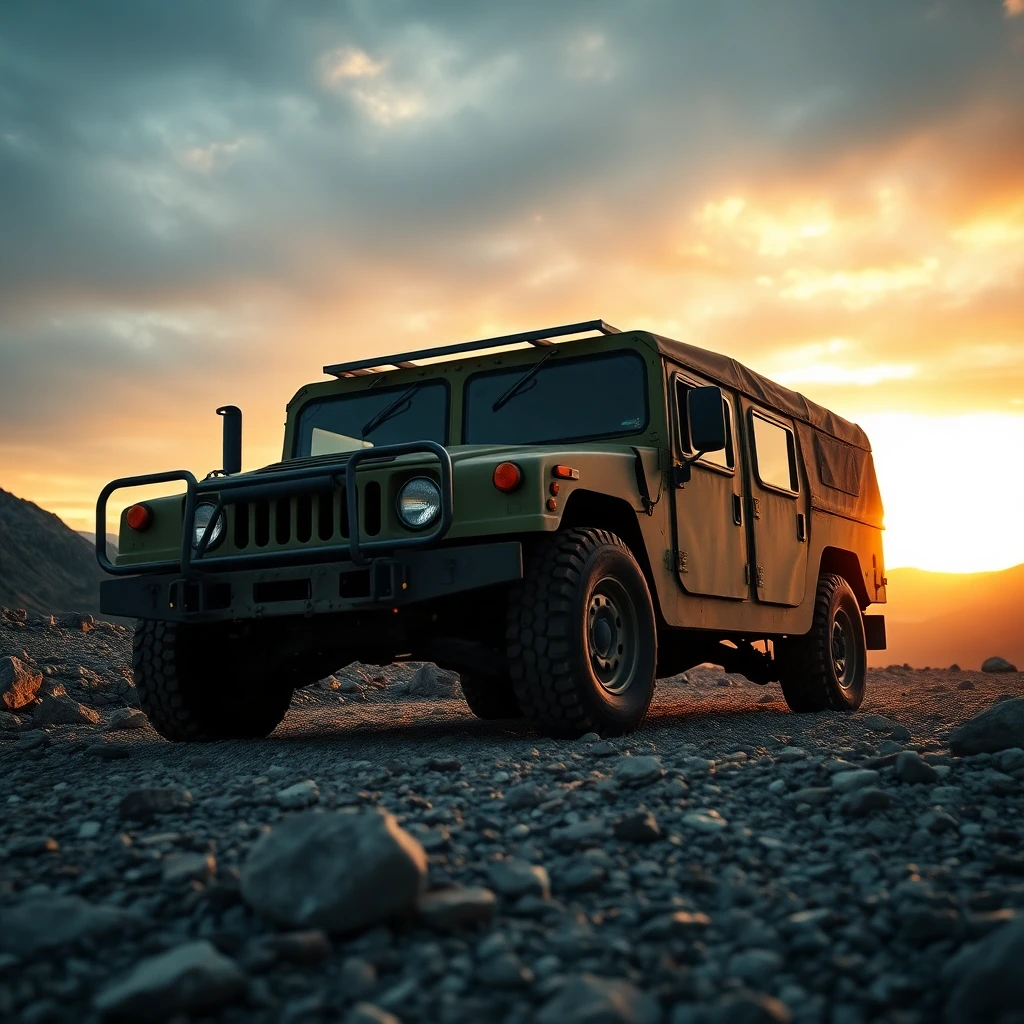
The difference between a Humvee and an M1114 Up-Armored HMMWV comes down to one word: survivability. Both vehicles share the same High Mobility Multipurpose Wheeled Vehicle platform, but the M1114 was purpose-built to take a hit and keep moving. If you're sourcing a surplus HMMWV, buying at GovPlanet, or trying to figure out what variant you already own, this breakdown covers every meaningful difference between a standard Humvee and the M1114, including what those differences mean when it's time to title and plate it.
The HMMWV family spans dozens of configurations. Understanding which variant you have matters for registration paperwork, weight ratings, and street-legal modifications. This guide covers the core distinctions, the armor package details, the performance tradeoffs, and the registration path for both types.
Honest answer: the M1114 is heavier, more expensive to modify, and harder to register without the right paperwork. But it's also one of the most capable surplus military vehicles a civilian can own.
What Is a Standard Humvee (HMMWV) and Where Did It Come From?
The HMMWV, produced by AM General, entered U.S. military service in 1984. It replaced the old M151 jeep and the 1/4-ton utility truck across multiple branches. The platform was designed for mobility, versatility, and field maintenance, not for absorbing improvised explosive device (IED) blasts or small arms fire.
Early variants like the M998 (cargo/troop carrier) and M1025 (armament carrier) were built light. Curb weights typically sit between 5,200 and 6,400 pounds depending on configuration. The standard powertrain is a 6.2L or 6.5L GM diesel, paired with a TH400 or 4L80E automatic transmission. Payload capacity on the M998 is around 2,500 pounds.
Common Standard HMMWV Variants
- M998: Basic cargo and troop carrier, no armor, open or soft-top configurations
- M1025 / M1026: Armament carrier with ring mount, hardtop, minimal armor provisions
- M1035: Soft-top ambulance configuration
- M1043 / M1044: Armament carriers with some armor provisions
These vehicles were not designed to survive direct fire. They were mobility platforms. That gap in protection became very visible during early operations in Iraq and Afghanistan, which is what drove the development of the Up-Armored variants.
How the Standard HMMWV Compares to a Jeep
People often ask about the difference between a Jeep and a Humvee or HMMWV. A Jeep is a compact, light off-road vehicle with roots going back to World War II. The HMMWV is roughly three times the weight of a CJ-era Jeep and was built for a completely different mission set. The HMMWV replaced the Jeep in U.S. military service. They're not comparable in capability, size, or mechanical complexity.
What Makes the M1114 an Up-Armored HMMWV?
The M1114 is the most widely recognized Up-Armored HMMWV variant. It entered production in the late 1990s and was fielded in large numbers during Operations Iraqi Freedom and Enduring Freedom. The "up-armored" designation isn't cosmetic. The M1114 features factory-installed armor protection as part of its core structure, not bolted-on add-ons.
Ready to register your vehicle?
Join thousands of vehicle owners who use HMMWV Registration to handle their registration quickly.
Get Started →The armor package on an M1114 includes ballistic steel door panels, a reinforced roof, blast-resistant floor, and armored glass rated for small arms fire. This protection is integrated into the body, not retrofitted. That's a key structural distinction from Supplemental Armor System (SAS) kits added to standard HMMWVs in the field.
M1114 Armor Specifications
- Protection level: Rated against 7.62mm ball ammunition and fragmentation
- Armored glass: Multi-layer laminate, roughly 1.5 inches thick
- Door panels: Ballistic steel construction, significantly heavier than standard aluminum doors
- Floor: Blast-attenuating design, reduces IED underbelly damage
- Roof: Reinforced steel, supports crew-served weapon mounting without structural flex
Engine and Drivetrain Upgrades on the M1114
Because the M1114 is substantially heavier, AM General upgraded the powertrain to compensate. The M1114 uses the 6.5L turbocharged diesel, producing approximately 190 horsepower and 380 lb-ft of torque. That's a meaningful improvement over the naturally aspirated 6.2L in earlier variants. The transmission is a 4L80E automatic, and the suspension is upgraded with high-output coil springs and heavier-duty shocks to handle the additional mass.
Gross Vehicle Weight Rating (GVWR) on the M1114 runs approximately 10,800 to 12,100 pounds depending on configuration. That's significantly heavier than a standard M998, and it has direct implications for registration class, weight fees, and some state-specific street-legal requirements. For a detailed look at what DOT standards apply to your specific variant, the DOT Requirements for Military Vehicles guide covers the weight and equipment thresholds that matter most for civilian plating.
Side-by-Side: Standard HMMWV vs M1114 Up-Armored HMMWV
Here's a direct comparison of the most significant specifications between a baseline M998-family HMMWV and the M1114 Up-Armored variant. Numbers are approximate and vary by production year and configuration.
| Specification | Standard HMMWV (M998-family) | M1114 Up-Armored HMMWV |
|---|---|---|
| Curb Weight | 5,200, 6,400 lbs | 9,500, 11,000 lbs |
| GVWR | 7,700 lbs | 10,800, 12,100 lbs |
| Engine | 6.2L or 6.5L GM Diesel (NA) | 6.5L Turbocharged Diesel |
| Horsepower | ~130, 150 hp | ~190 hp |
| Armor | None (base models) | Factory ballistic steel + armored glass |
| Doors | Aluminum or soft-sided | Ballistic steel, armored glass |
| Suspension | Standard coil springs | Heavy-duty, upgraded for increased weight |
| Top Speed (governed) | ~70 mph | ~55, 65 mph (weight-limited) |
| Civilian Availability | Common via DRMO / GovPlanet | Less common, stricter DEMIL requirements |
| Street-Legal Modification Difficulty | Moderate | Higher (weight class, DEMIL considerations) |
Demilitarization and Civilian Ownership: What Changes with an M1114?
This is where things get practical for buyers. Surplus military vehicles go through a DEMIL (demilitarization) process before civilian sale. Standard HMMWVs, classified at DEMIL Code A or B, typically don't require destruction of major components. The M1114 can carry a higher DEMIL classification depending on its armor specification and original mission configuration.
What DEMIL Means for the M1114
The integrated armor on an M1114 can complicate DEMIL clearance. Some M1114s released through the Defense Reutilization and Marketing Office (DRMO) have had armor panels removed or rendered inoperable before civilian sale. What you actually receive may differ from what you expect. Always confirm what's present before purchase. The SF-97 (Standard Form 97, the title document for demilitarized military vehicles) should accompany any legitimate surplus sale. A detailed breakdown of that process is available in the SF97 Title Process guide, which covers exactly what you need to convert that document into a civilian title.
The Difference Between a Demilitarized HMMWV and a Civilian Humvee
A demilitarized HMMWV is a surplus military vehicle that has passed through the DoD disposition process and is now compliantly owned by a civilian. A civilian Humvee, typically the H1 produced by AM General for the consumer market from 1992 onward, was built to civilian standards from the start. It has a proper manufacturer's certificate of origin (MCO), standard VIN format, and can be titled like any other vehicle. The demilitarized HMMWV requires an SF-97 and a state title process that varies considerably by state. These are not the same paperwork path, and confusing them is one of the most common title problems buyers run into. For context on what title red flags look like in practice, see Military Vehicle Title Red Flags Every Buyer Needs to Know.
Street-Legal Considerations for the M1114 vs Standard HMMWV
Getting any HMMWV street-legal requires attention to lighting, mirrors, turn signals, and sometimes speedometers. The M1114 adds weight-class complexity. At over 10,000 pounds GVWR, it may fall into a different registration category in some states, which can mean commercial vehicle requirements, additional inspections, or higher fees.
Weight Class and Registration Impact
Montana and South Dakota, two of the most HMMWV-friendly registration states, handle heavy military vehicles well. Montana has no emissions testing and no sales tax, which matters significantly when the vehicle's value and modification cost are already high. But weight-based fees still apply, and the M1114's higher GVWR will affect those. A full breakdown of what modifications are actually required before you can drive on public roads is covered in Humvee Street Legal Modifications: What Your HMMWV Actually Needs.
Lighting and Safety Equipment on the M1114
The M1114's military lighting package is not street-legal as-issued. Blackout drive lights, convoy markers, and military-spec turn signals don't meet civilian DOT requirements. Both standard HMMWVs and the M1114 need the same basic lighting upgrades: DOT-compliant headlights, turn signals front and rear, brake lights, and reflectors. The M1114's reinforced body can actually make some of these installations more involved, since you're working through thicker door panels and a heavier roof. For specifics on what equipment your HMMWV needs before it can be plated, Humvee Lighting Requirements for Street Legal Operation covers the full list.
Also worth knowing: the M1114's armored glass can create visibility challenges that some states consider during inspection. Check your state's requirements carefully. The Military Vehicle Safety Requirements guide has state-specific context for HMMWV owners.
Frequently Asked Questions
Is an M1114 the same as a Humvee?
The M1114 is a specific variant of the HMMWV platform, which is the military designation for what's commonly called a Humvee. All M1114s are HMMWVs, but not all HMMWVs are M1114s. The M1114 is distinguished by its factory-integrated armor package, upgraded turbocharged engine, and heavier GVWR. Think of the HMMWV as the platform family and the M1114 as one of the most heavily configured members of that family.
Can civilians buy and own an M1114 Up-Armored HMMWV?
Yes, in most cases. M1114s do appear at DRMO auctions and on GovPlanet, though less frequently than standard variants. The key requirement is that the vehicle has been properly demilitarized and comes with an SF-97. Some M1114s released to the public have had armor components removed or modified as part of the DEMIL process. Confirm the vehicle's condition and paperwork status before purchase. After acquisition, the SF-97 is used to obtain a civilian title through your state, or through a state like Montana or South Dakota if you use an out-of-state registration path.
How much heavier is an M1114 than a standard HMMWV?
Significantly. A baseline M998 HMMWV has a curb weight around 5,200 to 6,400 pounds. The M1114, with its factory armor package, typically weighs between 9,500 and 11,000 pounds at the curb. That's roughly 60 to 80 percent heavier. The weight difference affects towing capacity of the vehicle itself, tire wear, brake performance, and registration weight class. Plan accordingly if you're modifying one for regular street use.
What is the black box on the front bumper of some HMMWVs?
That flat, black box mounted upright on the front bumper is typically a CREW (Counter Radio-Controlled IED Electronic Warfare) device mount or a communications antenna base. On some configurations, it houses a vehicle identification transponder or convoy signaling device. In civilian ownership, these housings are typically empty shells. The actual electronics were removed as part of DEMIL. They're structural mounts, not functional equipment, on most surplus vehicles you'll encounter. Some owners remove them for aesthetics; others keep them as part of the vehicle's authentic appearance.
Does the M1114 have a different VIN format than standard HMMWVs?
HMMWV VINs don't follow the standard 17-character civilian VIN format. Military vehicle identification numbers are typically shorter, alphanumeric serial numbers assigned by the military. For registration purposes, states that process military vehicle titles, including Montana and South Dakota, accept these serial numbers as the vehicle identifier. The SF-97 document captures this number and ties it to the specific vehicle. For VIN-related questions, the NHTSA VIN Lookup tool can help confirm whether a civilian-format VIN has been assigned to your vehicle.
Is an M1114 street legal out of the box?
No. Like all surplus HMMWVs, the M1114 leaves military service without the lighting, reflectors, and equipment required for civilian road use. The military specification build does not include DOT-compliant headlights, proper turn signals, or civilian-standard mirrors. The M1114 also requires a valid civilian title before it can be registered. The modification list is manageable, but the weight class and armored glass specifics may add steps depending on your state. Montana registration is often the preferred path because there's no emissions testing and the process works for heavy surplus vehicles. See the full breakdown at Street Legal Humvee: What It Actually Takes to Get Plated and Drive on Public Roads.
What's the difference between a Humvee, an HMMWV, and an AM General HUMMER?
HMMWV is the military designation: High Mobility Multipurpose Wheeled Vehicle. Humvee is the widely recognized commercial name for the same vehicle. AM General HUMMER (later abbreviated to H1) is the civilian consumer version, sold from 1992 to 2006, built to civilian standards with a proper MCO and civilian VIN. The H2 and H3 are General Motors products that share the Hummer name but are truck-based SUVs with no direct military lineage. When someone says "HMMWV" or "Humvee," they're typically talking about the military or demilitarized version. The H1 is a distinct civilian build of the same platform.
Ready to Register Your HMMWV or M1114?
Whether you own a baseline M998, an M1025 armament carrier, or a fully armored M1114, the registration path starts with the same document: an SF-97 and a clear understanding of your vehicle's DEMIL status. Montana and South Dakota are the two most practical out-of-state options for HMMWV owners nationwide, offering no sales tax and a registration process built to handle surplus military vehicles. We manage the out-of-state paperwork with our paperwork support so you're not sorting through DoD documents alone.
For more on how military vehicle registration works across all 50 states, the Register Military Vehicle in Any State guide is the place to start. You can also check the Vehicle Info for Military Surplus Owners page to confirm what documentation you'll need before you start your registration.
The M1114 is a formidable machine. Getting it properly titled and plated is a solvable problem, and you don't have to sort it out alone.
Related Reading